


 PLATFORM UPDATE:

Rational design of diterpene-derived amphiphilic nanostructures for microbial flocculation in wastewater treatment
 *a
Rustem
Gamirov,
a
Yulia
Panina,
a
Evgeniya
Sokolova,
b
Dmitriy
Stoikov,
a
Dmitriy
Shurpik
a
and
Ivan
Stoikov
*a
*a
Rustem
Gamirov,
a
Yulia
Panina,
a
Evgeniya
Sokolova,
b
Dmitriy
Stoikov,
a
Dmitriy
Shurpik
a
and
Ivan
Stoikov
*a
Abstract
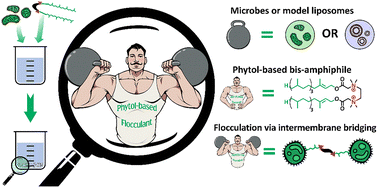
A rational approach to the design of phytol-based flocculants was applied to develop bis-amphiphilic organic molecules capable of selectively flocculating microorganisms. Several derivatives were synthesized via nucleophilic alkylation of symmetrical diamines with lipophilic phytol moieties, among which the TEMED-based compound exhibited the highest flocculation activity. Its flocculation ability was confirmed against Gram-positive bacteria (Staphylococcus aureus, Staphylococcus epidermidis) and fungi (Saccharomyces cerevisiae, Candida sp.), showing complete aggregation and zeta potential inversion. In contrast, Gram-negative bacteria (Klebsiella pneumoniae, Pseudomonas aeruginosa) displayed only partial flocculation, attributed to the barrier function of the outer membrane. Mechanistic studies using turbidimetry, dynamic light scattering, and transmission electron microscopy revealed that flocculation is mediated by hydrophobic interactions of terpene fragments with lipid bilayers and electrostatic binding of cationic centers to anionic motifs, resulting in intermembrane bridging and aggregate formation. These findings demonstrate that compact amphiphilic architectures can act as “molecular anchors” enabling effective flocculation without polymeric networks. This principle opens up the possibility of developing environmentally relevant nanostructures for microbial control and environmental nanotechnology in sustainable water purification.
 Please wait while we load your content...


