


Curved macrocyclic nanocarbons with tunable electronic and nonlinear optical properties: theoretical insights
 *a
and
Guochun
Yang
b
*a
and
Guochun
Yang
b
Abstract
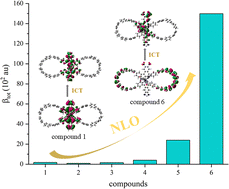
Molecular nanocarbons that integrate negatively curved nanographene with carbon nanorings provide a unique platform for manipulating π-electronic structures through three-dimensional topology. Here, a family of curved molecular nanocarbons constructed by fusing an octabenzo[8]circulene (OB8C) core with two [9]cycloparaphenylene ([9]CPP) units is systematically investigated using density functional theory (DFT) and time-dependent DFT calculations, with emphasis on structure–property relationships governing optical and nonlinear optical (NLO) behaviors. The calculated UV-vis spectrum of the parent molecule reproduces experimental data well, confirming the reliability of the computational model. Owing to its intrinsically chiral and fully π-conjugated framework, the parent compound already exhibits a measurable second-order NLO response. Guided by steric and electronic design principles, a series of derivatives is constructed by tuning phenyl substitution and introducing electron-donating (–NH2) and electron-withdrawing (–NO2) groups on the OB8C core. These modifications enable precise control over frontier orbital distribution, HOMO–LUMO gaps, and charge-transfer characteristics. As a result, the total first hyperpolarizability (βtot) can be modulated by nearly 3 orders of magnitude, ranging from 0.28 to 161.82 × 10² au at the CAM-B3LYP/6-311+G(d,p) level. In particular, donor–acceptor substitution induces pronounced intramolecular charge separation, leading to a dramatic enhancement of the second-order NLO response. This work elucidates how curvature, steric modulation, and electronic substitution cooperatively govern optoelectronic properties, highlighting curved macrocyclic nanocarbons as promising platforms for high-performance nonlinear optical materials.
 Please wait while we load your content...


