


A Janus hydrogel skeleton-encapsulated yarn-based evaporator for excellent desalination and lithium enrichment
 *ab
*ab
Abstract
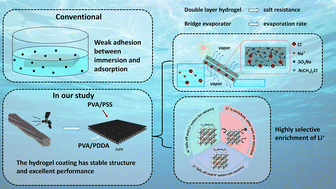
Conventional lithium extraction from seawater is limited by the difficulty of recovering dispersive adsorbents and a high material loss rate. In this study, a Janus hydrogel skeleton porous fabric (JSPF) evaporator based on hydrogel-coated yarn is reported for simultaneous high-efficiency seawater desalination and lithium extraction. The Janus hydrogel skeleton porous structure significantly improves the contact efficiency of the lithium-ion sieve H1.5MnFe2O4 with seawater and increases the surface roughness and utilization efficiency of the JSPF, thus enhancing the seawater desalination and lithium extraction performance. The selective separation of the anion and cation structure of the Janus hydrogel allows for effective separation of salt ions and stable salt-resistant properties. Owing to the significantly reduced evaporation enthalpy of water within the hydrogel, the evaporator demonstrates an evaporation rate of 3.43 kg m−2 h−1. Utilizing the photothermal conversion properties of H1.5MnFe2O4 to provide the heat required for evaporation, its adsorption capacity for Li+ reaches up to 972.4 mg m−2. This work presents a green and innovative technology to address freshwater scarcity in coastal and lithium-rich brine regions, while simultaneously securing raw material supplies for the lithium industry.
 Please wait while we load your content...


