


 PLATFORM UPDATE:


Photochromic nanofiber-based transparent composite films and their application in information encryption
 *ab
*ab
Abstract
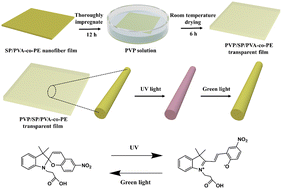
Stimuli-responsive color-changing materials can produce intuitive visual feedback to environmental stimuli and have received great attention in the fields of anti-counterfeiting, intelligent monitoring and smart windows. Herein, the autonomously synthesized spiropyran was successfully introduced into a poly(vinyl alcohol-co-ethylene) (PVA-co-PE) nanofiber film by a simple grafting method, which endowed the nanofiber film with excellent discoloration behavior in response to UV light stimulation. Experimental results show that when the graft concentration of spiropyran was controlled at 1 wt%, the prepared photochromic SP/PVA-co-PE nanofiber film could completely change from yellow-green to purplish red under ultraviolet irradiation for 10 s, and quickly return to the initial yellow-green state after 120 s of green light irradiation. Then, the SP/PVA-co-PE nanofiber film was combined with polyvinylpyrrolidone (PVP) to obtain the PVP/SP/PVA-co-PE transparent film, which not only retained excellent photochromic function, but also had a high optical transparency of 89.63%, and its thermal stability and mechanical properties were greatly improved. Finally, after clever design, the PVP/SP/PVA-co-PE composite film was applied to two-dimensional code recognition and hidden information encryption, which may provide great inspiration for future intelligent applications in the fields of encryption, anti-counterfeiting and visual smart windows.
 Please wait while we load your content...


