


Lithium-decorated porous BC2P monolayer: a novel high-capacity material for efficient and reversible hydrogen molecule storage

Abstract
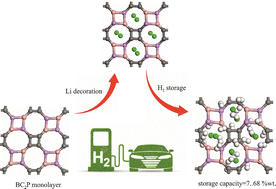
The hydrogen storage capabilities of pristine and lithium-decorated porous BC2P monolayers have been systematically investigated using density functional theory calculations. Our results reveal that the pristine BC2P monolayer exhibits limited hydrogen storage capability due to weak physisorption of H2 molecules. Lithium atoms preferentially adsorb on the eight-membered rings of BC2P with a binding energy of −2.75 eV per Li atom, which significantly exceeds the cohesive energy of bulk lithium, effectively preventing metal clustering on the surface. This strong interaction is further supported by high diffusion barriers (0.55–0.97 eV), ensuring the structural stability of the decorated system. The charge redistribution upon Li decoration generates a localized electric field that substantially enhances hydrogen adsorption, allowing each Li atom to accommodate up to three hydrogen molecules with average adsorption energies ranging from −0.20 to −0.28 eV, well within the optimal range for reversible storage proposed by the U.S. Department of Energy (DOE). The fully decorated Li8@BC2P system achieves a gravimetric hydrogen storage capacity of 7.68 wt% and an estimated volumetric capacity of 59.1 g L−1, exceeding both the ultimate DOE targets. Occupation number analysis and ab initio molecular dynamics simulations confirm that the adsorbed hydrogen molecules can be released under moderate temperature and pressure conditions, indicating excellent reversibility. Therefore, based on our theoretical predictions, the Li-decorated porous BC2P monolayer is emerging as a promising candidate for reversible hydrogen storage, warranting further experimental investigation to assess its feasibility for practical applications.
 Please wait while we load your content...


