


Novel triple-layer nanofibrous composite membranes with high gas selectivity for efficient blood oxygenation
 *a
*a
Abstract
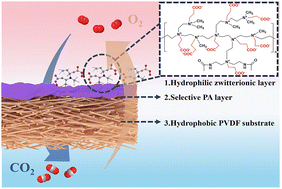
Oxygenation membranes, as the central component of extracorporeal membrane oxygenation (ECMO), face the challenge of simultaneously achieving high gas permselectivity and hemocompatibility. Herein, we designed an integrated triple-layer Janus composite membrane with excellent comprehensive performance by performing reverse-interfacial polymerization (R-IP) twice, followed by zwitterionic modification. The hydrophobic polyvinylidene fluoride (PVDF) nanofibrous substrate functioned as a plasma-leakage barrier while providing a low-resistance pathway for gas permeance. The middle selective polyamide (SPA) layer consisted of an ultrathin auxiliary PA (APA) layer fabricated using low concentrations of organic trimesoyl chloride (TMC) and aqueous polyethyleneimine (PEI) solutions (via the first R-IP step) and a dense PA (DPA) layer fabricated using high-concentration solutions (via the second R-IP step) to achieve high CO2/O2 permselectivity and an amino-rich surface. The initial APA layer effectively sealed most macropores of the nanofibrous substrate and provided a relatively smooth interface, facilitating uniform loading and diffusion of the organic phase for fabricating a compact DPA layer in the second R-IP step. The top hydrophilic zwitterionic layer was formed by N-methylation of the abundant unreacted amino groups from residual PEI and subsequent quaternization with 3-bromopropionic acid (3-BPA) to generate carboxybetaine zwitterionic structures on the SPA layer for improving hemocompatibility. The resultant triple-layer Janus composite membrane exhibited adequate gas permeance (O2 permeance of 131.5 GPU and CO2 permeance of 1578.6 GPU) and high CO2/O2 selectivity of ∼12.2. The zwitterionic surface concurrently enhanced membrane hydrophilicity, providing excellent resistance to thrombus formation and plasma leakage. This study successfully integrated an asymmetric Janus structure into oxygenation membranes, demonstrating its potential application in ECMO.
 Please wait while we load your content...


