


Design of EDTA-functionalized graphene oxide for efficient adsorptive elimination of Fe(iii) ions from water

Abstract
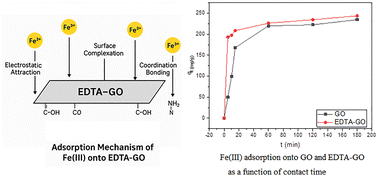
Graphene oxide (GO) nanosheets exhibit good chemical stability for water treatment applications. However, strong van der Waals interactions between adjacent nanosheets often lead to structural collapse, thereby reducing the exposed surface area and limiting electron/ion transport, which diminishes the adsorption efficiency. EDTA-functionalization of GO results in the formation of EDTA-GO nanosheets with a high density of chelating groups. This functionalization provides better stability of the material in solution and a high number of active sites, which lead to a superior ability to capture and remove pollutant ions efficiently. The functionalization process was conducted using a modified Hummers' method, followed by surface modification with ethylenediaminetetraacetic acid (EDTA). The resulting nanomaterial was characterized by FT-IR, XRD, and TEM techniques, confirming successful functionalization and changes in surface morphology. The adsorption behavior of EDTA-GO toward Fe(III) ions in aqueous solution was investigated under various conditions. Adsorption kinetics followed the pseudo-second-order model, indicating chemisorption as the predominant mechanism. Isotherm models (Langmuir, Freundlich, and Temkin) demonstrated a high adsorption capacity (1034 mg g−1) and favorable multilayer adsorption behavior. Thermodynamic parameters revealed that the adsorption process is spontaneous and endothermic. These results suggest that the EDTA-functionalized GO is a promising material for the efficient removal of heavy metals from water. The synthesized sample displayed a high maximum monolayer adsorption capacity of 1034 mg g−1 based on the Langmuir model, which is mainly attributed to the application of a modified strategy of synthesis in order to provide more accessible active sites. Thermodynamic analysis also indicated that the adsorption is a spontaneous and endothermic chemical sorption process (ΔH° = +65.327 kJ mol−1), which allows the mechanistic interpretation of the high complexation of Fe(III) ions with the EDTA functional moieties covalently bonded onto the GO matrix.
 Please wait while we load your content...


