


Extending the potential of MOF-derived LaFeO3@C: a sustainable solution for hexavalent chromium contamination

Abstract
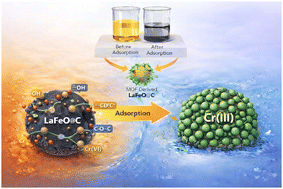
Hexavalent chromium [Cr(VI)] contamination poses a critical threat to environmental and human health, necessitating the development of efficient and sustainable adsorbent materials for mitigating the Cr(VI) pollution. Building upon our previous work, in which MIL 100(Fe)-derived LaFeO3@C was demonstrated to be an efficient adsorbent for organic dyes, we aimed to extend its applicability towards the more challenging task of Cr(VI) removal and its detoxification. The LaFeO3@C nanocomposite was synthesised via carbonization at 600 to 800 °C under an argon atmosphere and systematically evaluated for Cr(VI) adsorption under different operational parameters. Among the prepared samples, LFO@C-700 exhibited the highest removal efficiency, achieving 97.0% Cr(VI) reduction at pH 2 with an adsorbent dose of 0.6 g L−1 and a contact time of 24 h. Adsorption kinetics followed the pseudo-second-order model, indicating a chemisorption nature, while the equilibrium data were best described by the Langmuir isotherm with a maximum adsorption capacity of 127.71 mg g−1. Thermodynamic analyses confirmed that the adsorption process was spontaneous and endothermic. Furthermore, LFO@C-700 demonstrated strong Cr(VI) removal efficiency in real water samples, validating its potential for practical wastewater treatment. Overall, our study established MIL-100(Fe)-derived LFO@C nanocomposite as a robust, cost-effective, and environmentally sustainable adsorbent for toxic metal pollutants.
 Please wait while we load your content...


