


Room-temperature engineered cobalt-modulated Mn0.5Cd0.5S solid solutions for enhanced visible-light photocatalytic hydrogen evolution
 *a
*a
Abstract
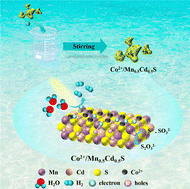
With the growing severity of energy and environmental issues, the development of efficient water splitting photocatalysts has emerged as a promising research direction. This work develops Co2+-modified Mn0.5Cd0.5S solid solutions as an efficient photocatalyst for solar hydrogen production. Through hydrothermal synthesis and room-temperature cobalt deposition, a series of Co2+/Mn0.5Cd0.5S composites exhibiting volcano-type activity dependence on Co2+ loading was engineered. The optimal catalyst achieves a maximum hydrogen evolution rate of 8146.2 µmol g−1 h−1 under visible light, which is 6.9 times that of pristine Mn0.5Cd0.5S. Mechanistic studies reveal that surface-anchored cobalt species provide additional active sites for proton reduction. Electrochemical analysis confirms reduction in charge transfer resistance and lower overpotential versus unmodified controls. This work demonstrates transition-metal surface engineering as a scalable strategy for designing high-performance sulfide photocatalysts.
 Please wait while we load your content...


