


Copper(ii) complexes of dipica and its derivatives as biomimetic models for phenoxazinone synthase: probing the effect of central N-cycloalkyl rings on reactivity

Abstract
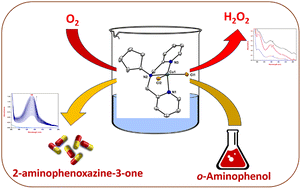
A series of copper(II) complexes 1–4 of the type [Cu(L1–L4)Cl2] incorporating tridentate 3N donor ligands L1–L4 were synthesized and evaluated as biomimetic models for phenoxazinone synthase enzyme (PHS). The ligands employed are bis(pyridin-2-ylmethyl)amine (L1, dipica), N,N-bis(pyridin-2-ylmethyl)cyclopropanamine (L2), N,N-bis(pyridin-2-ylmethyl)cyclopentanamine (L3), and N,N-bis(pyridin-2-ylmethyl)cycloheptanamine (L4). All the ligands and their copper(II) complexes were characterized by various spectroscopic and analytical methods. Out of the four complexes, complexes 2–4 are isostructural and exhibit a trigonal bipyramidal distorted square-based pyramidal geometry (TBDSBP) (τ5: 2a, 0.25, 2b, 0.296; 3, 0.399; 4, 0.209), encompassing a CuN3Cl2 chromophore around the copper(II) centre, as revealed by single-crystal X-ray diffraction analyses. The solution-state EPR studies of complexes showed g‖ = 2.23–2.25 and A‖ = 180–200 × 10−4 cm−1 values, and absorption spectral analysis (675–700 nm) clearly deduced the presence of square-based geometry in the solution state. All the complexes exhibit quasireversible Cu(II)/Cu(I) redox behavior and the E1/2 value of 3 (−0.143 V) is less negative than that of 1 (−0.224 V), 2 (−0.156 V) and 4 (−0.172 V) in aqueous solutions. Complexes 1–4 serve as the small-molecule models of PHS by catalyzing the conversion of 2-aminophenol into phenoxazinone in an aqueous medium and display significant kcat values of 1810–4210 h−1 in H2O. Interestingly, the turnover number of 3 is significantly higher than that of 1, 2 and 4 in an aqueous solution. Indeed, complex 3, appended with the conformationally less flexible and sterically demanding cyclopentyl group, forces the basal plane donor atoms to move away from the central copper(II) ion, shows enhanced Lewis acidity of the Cu(II) ion, which, in turn, promotes the CuII/CuI redox process during the catalytic cycle, and brings a higher turn-over number (4210 h−1) in PHS-mimicking catalysis.
- This article is part of the themed collection: Articles behind the 2026 journal covers
 Please wait while we load your content...


