


Bio-inspired manganese nanoparticles from pine needles with enhanced adsorptive performance

Abstract
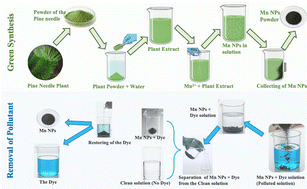
This study examines a sustainable approach for synthesizing manganese nanoparticles (Mn NPs) using pine needle extract. This green synthesis method leverages the abundant phytochemicals in pine needles, offering a sustainable alternative to conventional chemical methods, minimizing the use of harmful reagents, and alleviating environmental impacts. The synthesized Mn nanoparticles were thoroughly evaluated using widely employed analytical methods, providing insights into their morphology, functional groups, and textural properties. The Mn NPs were evaluated for their efficacy in adsorbing methylene blue (MB), demonstrating their potential as cost-effective, efficient adsorbents for environmental remediation. The kinetic analysis showed that the pseudo-second-order model (R2 = 0.9983) provided the best fit, indicating that it accurately describes the adsorption process. Thermodynamic analyses revealed that the adsorption of MB dye onto Mn nanoparticles is spontaneous (ΔG° < 0) and exothermic (ΔH° = −32.02 kJ mol−1). The enthalpy value indicates physisorption, whereas the negative ΔS° indicates randomness at the solid–solution interface. The adsorption of MB dye onto Mn nanoparticles was assessed using Langmuir, Freundlich, and Temkin isotherm models, with a separation factor of 0.059. The Freundlich model (R2 = 0.9931) provided the best fit, indicating a physisorption mechanism characterized by multilayer adsorption and weak van der Waals interactions. This study highlights the combined benefits of green synthesis, morphological optimization, and practical application, promoting the development of sustainable nanomaterials for diverse industrial and environmental applications.
 Please wait while we load your content...


