


 PLATFORM UPDATE:

Experimental and DFT approaches to the physico-chemical properties of methotrexate silver clusters

Abstract
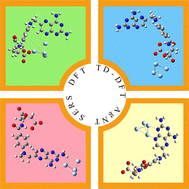
This article presents the results of experimental and theoretical studies on the physico-chemical properties of metal–organic compounds, using silver clusters and the drug “methotrexate”. The thermodynamic parameters for adsorption and the energy levels of the orbitals for several models of these compounds were calculated to better understand the features of their adsorption on metal clusters. It was found that the adsorption of methotrexate onto the surface of nanoparticles occurs through the carboxyl groups on the molecule. A specific Raman band corresponding to adsorption was revealed at 1586 cm−1 and confirmed with DFT calculations. Analyses using critical point calculations, quantum theory of atoms in molecules (QTAIM), indices of conceptual density functional theory (CDFT), visualization of electron localization function (ELF), localized orbital locator (LOL), non-covalent interaction (NCI), interaction region indicator (IRI) isosurfaces, and RDG graphs were also carried out for metal–organic complexes. The possibility of charge transfer from the cluster to the molecule is demonstrated when the complex is excited at a wavelength of 532 nm and the calculated energy parameter is 2.33 eV. The obtained results clarify the issues of surface chemistry during the design of SERS sensors based on silver nanoparticles and highlight the critical spectral shifts for the registration of the drug “methotrexate”.
 Please wait while we load your content...


