


Eco-friendly production of reduced graphene oxide from spent dry cell batteries for bifunctional bioelectricity generation and heavy metal removal in microbial fuel cells

Abstract
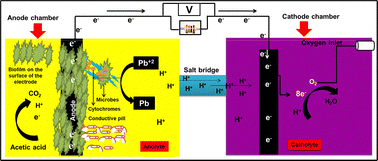
In this study, the anode of a double-chamber micro-biofuel cell was fabricated using graphene oxide (GO) and reduced graphene oxide (rGO) derived from waste dry-cell graphite electrodes. This material was developed to enhance electron transfer while simultaneously removing lead (Pb2+) ions from wastewater. The synthesized materials were characterized using UV-Vis, SEM–EDS, XRD, FTIR, BET and Raman spectroscopy to investigate its optical, morphological, and structural properties, molecular vibrational states, surface area and structural defects. Electrochemical performance was evaluated using cyclic voltammetry (CV) and electrochemical impedance spectroscopy (EIS). During 30 days of MFC operation, the anodes fabricated from GO and rGO nanoparticles achieved remediation efficiencies of 82% and 85%, respectively. The rGO anode also delivered a maximum power density of 72.4 mW m−2 and a current density of 927 mA m−2, both significantly higher than those of the GO anode (45.94 mW m−2 and 856 mA m−2, respectively). The final results of the produced anodes revealed that spent dry cell batteries (graphite electrode) are viable and affordable materials for improving MFC anode performance.
 Please wait while we load your content...


