


Preparation of a FeS/FeSn carbon cryogel for efficient removal of Cr(vi): adsorption performance and mechanism
 *a
and
*a
and
Abstract
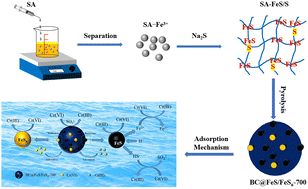
In the present study, sodium alginate (SA) was employed as the precursor and cross-linked with Fe3+ ions to form an SA–Fe3+ hydrogel. In an alkaline Na2S solution, the prepared hydrogel gradually released Fe3+ ions, which subsequently reacted with S2− ions to produce a uniformly dispersed alginate-FeS/S hybrid sol (denoted as SA-FeS/S). The SA-FeS/S sol was then converted into an FeS/FeSn carbon cryogel (BC@FeS/FeSn-T, where BC stands for biochar) through sequential freeze-drying and pyrolysis. The microstructure and composition of the resulting BC@FeS/FeSn-T cryogel were systematically characterized using scanning electron microscopy (SEM), Fourier transform infrared spectroscopy (FTIR), X-ray diffraction (XRD), and X-ray photoelectron spectroscopy (XPS). The performance for the adsorption of Cr(VI) and the corresponding reaction mechanism of BC@FeS/FeSn-700 were thoroughly investigated. Moreover, BC@FeS/FeSn-700 exhibited superior Cr(VI) removal efficiency over a wide pH range, making it a highly promising candidate for remediating Cr(VI)-contaminated soils. The adsorption process proceeded via five distinct pathways: (i) Cr(VI)'s reduction by Fe2+ and HS− species released from FeS; (ii) direct electron transfer from FeS; (iii) redox reactions with various iron sulfides (FeS2, Fe3S4, and Fe1−xS); (iv) reduction by sulfite ions; and (v) surface adsorption onto biochar or metal oxides.
 Please wait while we load your content...


