


Studies on the influence of cobalt- and iron-doping mechanisms on the adsorption of H2S, NO, NO2 and SO2 gas molecules by two-dimensional C9N4 materials

Abstract
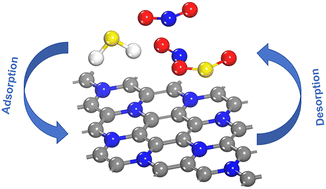
We have systematically investigated the influence of cobalt (Co)- and iron (Fe)-doping mechanisms on the adsorption of H2S, NO, NO2, and SO2 gas molecules by two-dimensional C9N4 materials using density functional theory (DFT) combined with the generalized gradient approximation with the Hubbard U correction (GGA+U) method. By constructing a 4 × 4 × 1 supercell model, the adsorption structures, thermodynamic parameters, electronic structures, and charge transfer characteristics of different doping systems were determined. By analyzing the recovery time at different temperatures, the regulation patterns of adsorption selectivity by the d-electron configuration of transition metals were revealed. The structure optimization results show that gas molecules are mainly adsorbed in an end-on coordination mode on the surface of Co-/Fe-doped C9N4. The adsorption energies of the Co-doped system for H2S, NO, and NO2 (−2.553 to −1.919 eV) are significantly higher than those of the Fe-doped system (−2.228 to −0.393 eV). The adsorption energy of Co-C9N4 for NO (−2.553 eV) is 89% higher than that of Fe-C9N4 (−1.347 eV), which is attributed to the superior d-orbital hybridization ability of Co2+ (3d7). Density of states (DOS) analysis showed that the orbital hybridization energy gaps between Co3+ and gas molecules (−3.5 eV and −2 eV in the H2S system) are lower than those in the Fe3+ system (−1 eV in the H2S system), confirming that the Co-doped system has stronger bonding stability. Differential charge density calculations showed that the charge-transfer value of Fe-C9N4 for NO (0.43 e) is 48% higher than that of Co-C9N4 (0.29 e), which originates from the electron donation–acceptance flexibility of the half-filled configuration of Fe3+ (3d5). SO2 in Fe-C9N4 has recovery times of 9.46 × 10⁻⁹–4.4 × 10⁻⁶ s at 298–498 K, balancing stability and desorption, providing a basis for designing selective 2D gas-sensing materials.
 Please wait while we load your content...


