


A novel electrochemical sensor based on CuFe2O4/γ-CD loaded reduced graphene oxide nanocomposites: enabling the detection of metformin in water and soil
 *b
*b
Abstract
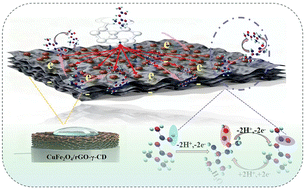
Metformin (MET) has emerged as a contaminant of concern, prompting regulatory bodies' vigilance due to its potential detrimental impacts on both the ecosystem and human health. Consequently, there is an urgent need for the development of rapid, portable, and cost-effective sensors capable of detecting MET in environmental samples. In this study, we successfully constructed a rapid and highly selective electrochemical sensor for MET using CuFe2O4 nanoparticles/γ-cyclodextrin loaded reduced graphene oxide (CuFe2O4/γ-CD/rGO) nanomaterials. The incorporation of γ-CD facilitated the dispersion of rGO, while the large surface area, good conductivity and adsorption properties of rGO enhanced the loading capacity of CuFe2O4 nanoparticles, thereby improving the conductivity of the composite material. Various spectral and analytical techniques were employed to thoroughly characterize the morphology and structure of the synthesized nanocomposites. The electrocatalytic performance of the CuFe2O4/rGO/γ-CD modified electrode towards MET was evaluated through differential pulse voltammetry (DPV), Cyclic voltammetry (CV), and electrochemical impedance (EIS). Under optimal conditions, the CuFe2O4/rGO/γ-CD electrode exhibited a satisfactory linear range from 2 µM to 60 µM, with a limit of detection (LOD) of 0.6 µM (S/N = 3). Furthermore, the developed sensor demonstrated several advantages, including low cost, excellent accuracy, simple structure, high selectivity and reproducibility. It was successfully employed for the detection of MET in environmental river water and soil samples, yielding satisfactory recovery rates and consistent results compared to the UV-vis method.
 Please wait while we load your content...


