


Regulation mechanism of secondary encapsulation in the leaching of Guizhou's Carlin-type gold ore with sodium hypochlorite
Abstract
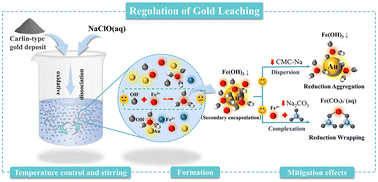
During the extraction of gold, the cyanidation step poses significant environmental risks. In this study, an environmentally friendly alternative was proposed based on the use of alkaline sodium hypochlorite (NaClO) to leach Carlin-type gold ores. Thermodynamic analysis confirmed that NaClO simultaneously liberated and dissolved gold. Single-factor optimisation achieved a limited leaching efficiency of 88.31% owing to the secondary encapsulation of the Fe(OH)3 precipitates. To overcome this issue, Na2CO3 and sodium carboxymethyl cellulose (CMC-Na) were introduced as regulatory agents. Comprehensive analyses using scanning electron microscopy-energy-dispersive X-ray spectroscopy, X-ray photoelectron spectroscopy, and electrochemical measurements revealed that sodium carbonate prevented Fe(OH)3 formation via complexation, while CMC-Na dispersed existing aggregates. Consequently, the gold leaching efficiency was increased significantly to 93.95% and 92.47%, respectively. This work provides theoretical guidance and technical support for the efficient and environmentally sustainable leaching of Carlin-type gold ores.
 Please wait while we load your content...


