


 PLATFORM UPDATE:


Dopant engineering for robust and efficient Ru-based electrocatalysts in proton exchange membrane water electrolysis
 †a
Toshali
Bhoyar,
†a
Jeonghyeon
Kim,
c
Subeen
Lee,
a
Haneul
Jin,
*b
Jin Young
Kim
*cd
and
Kwangyeol
Lee
*a
†a
Toshali
Bhoyar,
†a
Jeonghyeon
Kim,
c
Subeen
Lee,
a
Haneul
Jin,
*b
Jin Young
Kim
*cd
and
Kwangyeol
Lee
*a
Abstract
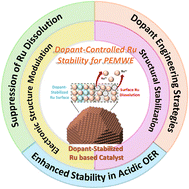
Proton exchange membrane water electrolysis is a key technology for sustainable hydrogen production, yet its widespread deployment is severely constrained by the reliance on scarce and expensive iridium-based oxygen evolution reaction (OER) catalysts. Ru oxide-based catalysts have emerged as a promising alternative owing to their intrinsically high OER activity and relatively lower cost. However, their practical application is fundamentally limited by rapid degradation under acidic and highly oxidative conditions. This instability originates from the intrinsic coupling between lattice-oxygen-driven reaction pathways, cation demetallation, and dynamic structural reconstruction during oxygen evolution. In this review, we present a mechanistic overview of dopant-driven strategies for stabilizing Ru-based electrocatalysts under water electrolysis. We summarize how dopant incorporation modulates Ru-O bonding, lattice oxygen reactivity, and reaction pathway selection, thereby suppressing Ru dissolution and structural collapse. Dopant effects are discussed in terms of lattice and phase stabilization as well as electronic and chemical modulation, encompassing substitutional, interstitial, and atomically dispersed dopants. By correlating mechanistic insights from operando spectroscopy and dissolution analyses with reported durability trends, this review establishes dopant engineering as a unifying design framework for reconciling activity and stability in Ru-based oxygen evolution catalysts.
- This article is part of the themed collection: Recent Review Articles
 Please wait while we load your content...


