


 PLATFORM UPDATE:


Beyond coatings: epitaxial interface engineering for high-energy liquid-electrolyte and solid-state batteries

Abstract
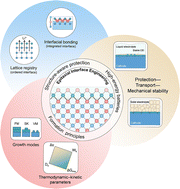
Interfacial instability limits the performance of high-energy batteries. In both liquid-electrolyte and solid-state battery systems, degradation at the cathode surface is critical, where electrolyte reactivity, lattice oxygen instability, transition-metal dissolution, and mechanical damage can develop together. Conventional coating strategies can mitigate parasitic reactions, but many coatings remain structurally discontinuous, weakly bonded to the cathode, or transport-limiting. This Perspective presents epitaxial interface engineering (EIE) as a route to more integrated cathode surface design. In battery materials, EIE does not require ideal thin-film epitaxy. It refers to thin, surface-localized structures that are crystallographically correlated with the cathode and chemically coupled to it through a bonded interface. Such architectures can stabilize reactive cathode surfaces while preserving ion and electron transport. We examine the definition and verification of EIE, the formation of growth-mode-derived architectures, and representative examples in liquid-electrolyte and solid-state batteries. Remaining challenges and future directions for EIE are discussed in the final section.
- This article is part of the themed collection: Recent Review Articles
 Please wait while we load your content...


