


 PLATFORM UPDATE:


Bacitracin-regulated injectable PHEMA hydrogels with intrinsic mild negative swelling for soft tissue repair
 *d
and
Yi
Wang
*ae
*d
and
Yi
Wang
*ae
Abstract
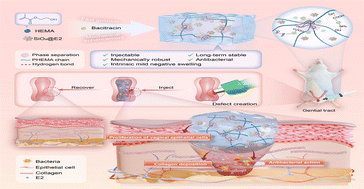
Injectable hydrogels are promising for minimally invasive soft-tissue repair, but post-gelation swelling in aqueous environments often causes dimensional instability and mechanical deterioration. Here, we report a bacitracin-regulated poly(2-hydroxyethyl methacrylate) hydrogel that combines rapid in situ gelation with intrinsic mild negative swelling under hydrated conditions. Bacitracin acts as a multifunctional molecular regulator, promoting gel formation and directing hydration-driven network evolution through multivalent hydrogen bonding and hydrophobic associations with PHEMA chains. As a result, the hydrogel undergoes mild contraction rather than conventional swelling expansion, without a pronounced overswelling stage. The resulting network exhibits improved mechanical stability, resistance to water-induced structural degradation, and bacitracin-associated antibacterial activity. After incorporation of estradiol-loaded mesoporous silica nanoparticles, the hydrogel enables sustained bioactive release and promotes vaginal wound healing in vivo. This work provides a peptide-regulated strategy for controlling post-gelation volume evolution in injectable hydrogels for moist soft-tissue repair.
 Please wait while we load your content...


