


 PLATFORM UPDATE:


Robust reconfigurable modular metamaterials with demand-driven elasto-plastic properties
 *a
*a
Abstract
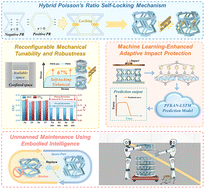
Having an inherent assembling ability, modular mechanical metamaterials can reconfigure geometry and adjust real-time performance. However, the unstable mechanical strength and limited local space flexibility of current assembly strategies impede the functional advancement of modular metamaterials, which lack intelligent solutions for on-demand reconfigurable environmental adaptation. Here, a novel self-locking assembly strategy is introduced, utilizing the coupling of positive and negative Poisson's ratios, enabling modular metamaterials to modify the structural deformation modes in confined spaces. Without volume expansion, it achieves controllable mechanical properties with 116% elastic stiffness adjustment, 189% stress strength change, and over 30% variation in energy absorption. Significantly, the self-locking mechanism improves stability in multi-layer configurations, surpassing current modular metamaterials by reducing overall stress fluctuations by up to 62.1% and nearly doubling the stability of local stress plateaus. Building on the evolution of mechanical properties and impact resistance, an enhanced KAN-LSTM model is developed to predict dynamic responses, with a specific focus on incorporating the assembly sequence. Despite the limited dataset, the model demonstrates excellent performance in fitting nonlinear impact responses and controlling average error. Compared to the original model, it improves nonlinear curve fitting on the test dataset within the sampled design space, reducing RMSE and MAE by approximately 20%. Additionally, post-experiment disassembly confirmed the excellent economic maintenance afforded by the modular strategy, with an average component recyclability of approximately 60.33%. Overall, this study offers a promising blueprint for reconfigurable modular core structural carriers in real-time perception and protection systems, with potential applications in port engineering, aerospace, and intelligent factories.
 Please wait while we load your content...


