


 PLATFORM UPDATE:


A high-performance radiative cooling glass based on multi-band selective regulation for synergistic heat dissipation and resistance
 *abc
*abc
Abstract
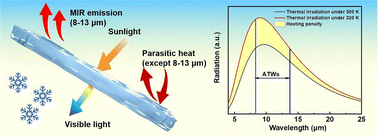
Visibly transparent radiative cooling (VTRC) glass offers a promising pathway for improving building energy efficiency. However, conventional designs of vertically installed VTRC materials often focus on optimizing emission or reflection across the entire mid-infrared (MIR) spectrum, neglecting the dual demand for outward radiative cooling and resistance to incoming thermal radiation from the surroundings. Herein, we proposed a strategy for selective mid-infrared regulation to overcome the above limitations and fabricated a multi-band selective regulation radiative cooling (MBSR-RC) glass through a simple blade-coating method. The fabricated MBSR-RC glass exhibited a precisely engineered spectrum. It maintained high VIS transmittance (85%), high NIR blocking (72%), and high emissivity (87%) in atmospheric transparent windows for heat dissipation, and a high reflectivity (60%) in the remaining MIR region to resist environmental heat. Consequently, compared with conventional radiative cooling glass and low-emissivity (low-E) glass under vertical installation, the multi-band selective regulation radiative cooling (MBSR-RC) glass achieved a maximized temperature reduction of 4 °C. Furthermore, it demonstrated high practicality, with high ultraviolet resistance, low thermal conductivity, and strong anti-raindrop stability. EnergyPlus simulations showed that, compared with normal buildings, an energy saving of 3.2 kWh m−2 could be achieved in buildings employing MBSR-RC. This work provides a novel and practical design strategy for energy-saving windows, showcasing significant potential for energy-efficient building applications.
 Please wait while we load your content...


