


 PLATFORM UPDATE:


Polyurethane elastomers based on triple reversible networks with accelerated self-healing by photothermal conversion
 *a
*a
Abstract
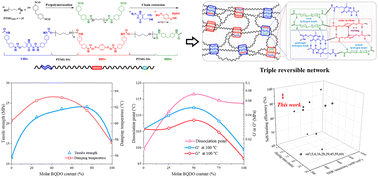
Thermoplastic polyurethane (TPU) supramolecular networks with hybrid hard segments composed of 1,4-benzoquinone dioxime (BQDO) and/or ureidopyrimidinone (UPy) (TPU-Q, TPU-U or TPU-QU) have been successfully achieved through pre-polymerization and subsequent chain extension. The composition of hard segments can be tuned by adjusting the feed ratio of BQDO to UPy, due to the high conversion of chain extenders. Triple reversible networks are constructed through the synergistic effects of various interactions in hard segments including abundant quadruple hydrogen bonds, ordered π–π stacking and oxime-urethane bonds. The BQDO structural units serve as both robust sites for ensuring network integrity and photothermal sites for accelerating network reorganization, and UPy structural units act as cooperated sites to enhance the network strength and hysteresis. The synergistic effects in hard segments increase the network strength and network reversibility simultaneously, leading to a high tensile strength of 24.1 MPa, a high dissociation point of 116.5 °C, a low activation energy for network reorganization of 43.6 kJ mol−1 and a wide damping range at low temperature. Robust self-healing of TPU-QU supramolecular networks has been achieved in the presence of NIR irradiation, leading to a high self-healing efficiency of 99.2% at NIR intensity of 200 mW cm−2 within 10 min. The accelerated self-healing is caused by strong and stable photothermal conversion achieved under 808 nm irradiation, since the aggregated BQDO structural units in HSs exhibit a narrow energy gap and thus a high photothermal temperature of 180 °C at NIR intensity of 500 mW cm−2. These TPU-QU elastomers would have potential applications in soft devices and photosensitive self-healing materials.
 Please wait while we load your content...


