


Strong hybridization driving unusual enhanced negative thermal expansion in PbTiO3-based ferroelectrics
 *ab
Sergey A.
Nikolaev,
b
Shogo
Kawaguchi,
f
Richeng
Yu,
a
Jun
Chen,
*e
Masaki
Azuma
*bc
and
Youwen
Long
*a
*ab
Sergey A.
Nikolaev,
b
Shogo
Kawaguchi,
f
Richeng
Yu,
a
Jun
Chen,
*e
Masaki
Azuma
*bc
and
Youwen
Long
*a
Abstract
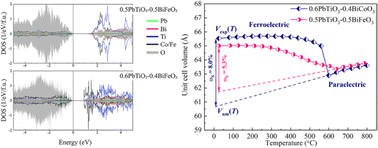
Materials with strong negative thermal expansion (NTE) are crucial for both fundamental research and thermal expansion control engineering. Our previous studies have shown that significantly enhanced NTE can be achieved in PbTiO3–BiFeO3 and PbTiO3–BiCoO3 ferroelectrics by improving the tetragonal distortion (c/a) of the parent PbTiO3. However, the detailed microscopic mechanisms behind this intriguing phenomenon remain unclear. In this study, we explored the temperature-dependent chemical bonding characteristics using high-energy synchrotron X-ray powder diffraction combined with Rietveld refinement, the maximum entropy method, and first-principles calculations. The temperature evolution of the electron density distribution in the ferroelectric phase of 0.5PbTiO3–0.5BiFeO3 and 0.6PbTiO3–0.4BiCoO3 provides direct evidence of strong covalency, not only in the A-site Pb/Bi–O2 bonds but also in the B-site Ti/Fe/Co–O1 bonds. This covalent character promotes spontaneous polarization through displacements of the highly polarizable A- and B-site cations. Our results reveal that the distinct covalent nature of the Fe–O and Co–O bonds results in contrasting temperature-dependent unit cell volume behaviors, with PbTiO3–BiFeO3 exhibiting strong nonlinear NTE and PbTiO3–BiCoO3 displaying colossal volume contraction. These findings elucidate the microscopic origin of the NTE in PbTiO3-based ferroelectrics and pave the way for the design of new materials with enhanced NTE properties.
 Please wait while we load your content...


