


 PLATFORM UPDATE:


Lead-free layered halide double perovskites with aromatic organic cations for resistive switching memories and artificial synapses
 abc
Konstantinos
Rogdakis,
ef
Shahab
Ahmad,
a
Satyajit
Sahu,
a
Emmanuel
Kymakis,
ef
Jovana V.
Milić
*cg
and
Mahesh
Kumar
*b
abc
Konstantinos
Rogdakis,
ef
Shahab
Ahmad,
a
Satyajit
Sahu,
a
Emmanuel
Kymakis,
ef
Jovana V.
Milić
*cg
and
Mahesh
Kumar
*b
Abstract
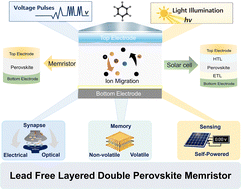
Integration of sensing, memory, and computing functionalities within a single device is a key step towards the development of efficient and compact artificial visual systems. Halide perovskite based memristors are promising candidates for such neuromorphic platforms due to their inherent optoelectronic properties and resistive switching capabilities. Using lead free layered double perovskites based on 1,4-phenylenedimethylammonium (PDMA) and benzylammonium (BzA) of (PDMA)2AgBiX8 and (BzA)4AgBiX8 (X = I and Br) compositions, we show that field and light-driven migration of halide ions and lattice incorporated Ag+ governs resistive switching and synaptic processes through an intrinsic mechanism, enabling electrical and optical synaptic responses. Depending on how ionic redistribution is stabilized or allowed to relax under different electrode and architectural boundary conditions, the same material exhibits both non-volatile memory and diffusive (volatile) switching essential for mimicking dynamic synaptic and neuronal processes. In solar cell configurations, the built-in junction field couples photocarrier generation with ionic motion, allowing zero-bias optical synaptic plasticity and self-powered operation for potential in-sensor computing. Electrical and optical synaptic responses emerge from this unified ion-dynamic process. Electrode and temperature dependence studies, transient measurements, polarity-switching analysis, and impedance spectroscopy provide consistent mechanistic signatures across operating modes. These findings position lead-free layered double perovskites as multifunctional and sustainable materials for neuromorphic technologies.
 Please wait while we load your content...


