


A microencapsulated linseed oil adhesive based on photosensitive indication: a smart material for visualized curing monitoring

Abstract
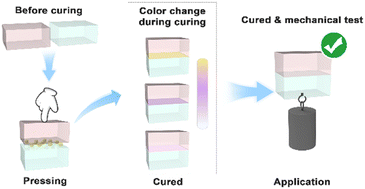
Detectable adhesives that provide real-time feedback on the curing status and bonding strength via colorimetric or electrical signals hold great promise for industrial quality control and intelligent manufacturing. However, systems that simultaneously offer non-destructive, instrument-free detection remain scarce, posing a critical challenge for their broader practical deployment. In this study, a design strategy for visually trackable adhesives that exhibit real-time, non-destructive curing-state indication is proposed, enabled by the incorporation of photochromic spiropyran molecules. The adhesive features a linseed oil core and a calcium alginate shell, allowing air-curable adhesion and mechanically triggered release. The system achieves a high transparency of over 95% and a maximum bonding strength of 15 MPa after full curing, demonstrating both optical and mechanical superiority. Compared to existing intelligent adhesives, this MLOA system integrates adhesion, visualization, and sustainability, while maintaining excellent performance under liquid nitrogen and solvent exposure and exhibiting strong compatibility with a wide range of substrates. This dual-feedback system bridges sensing and adhesion in a single platform, opening new avenues for real-time monitoring and adaptive control in next-generation smart manufacturing.
 Please wait while we load your content...


