
Beyond the melting point annealing of poly(vinylidene fluoride) for enhanced piezoelectric performance

Abstract

This study investigates the high temperature, beyond the melting point, and high stress, up to 450 MPa, stretch-annealing process of poly(vinylidene fluoride) and its impact on piezoelectric performance. Using this approach, films with moduli up to 11 GPa were fabricated. Contrary to conventional piezoelectric understanding, our results show a significant increase in the in-plane piezoelectric coefficient (e31) and electromechanical coupling coefficient (k31) with the high temperature–stress annealing despite the increased modulus. These films exhibited exceptional piezoelectric performances, with e31 values reaching ∼190 mC m−2 and k31 values to 0.25, among the highest reported for PVDF. Microstructural analysis suggests the formation of shish-kebab structures, highlighting the potential for microstructure engineering to enhance piezoelectric performance. These findings have implications for the future development of high-performance piezoelectric polymers.
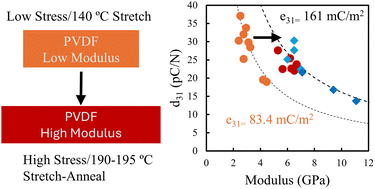
Graphical abstract: Beyond the melting point annealing of poly(vinylidene fluoride) for enhanced piezoelectric performance

Supplementary files

Transparent peer review

To support increased transparency, we offer authors the option to publish the peer review history alongside their article.

View this article’s peer review history

Article information

Article type
Communication
Submitted
27 Jun 2025
Accepted
07 Nov 2025
First published
24 Nov 2025

Mater. Horiz., 2026, Advance Article

Beyond the melting point annealing of poly(vinylidene fluoride) for enhanced piezoelectric performance

S. T. Hsieh, S. Ye, R. Jian, J. R. Peterson, H. Mei and A. J. Ouderkirk, Mater. Horiz., 2026, Advance Article , DOI: 10.1039/D5MH01226K

To request permission to reproduce material from this article, please go to the Copyright Clearance Center request page.

If you are an author contributing to an RSC publication, you do not need to request permission provided correct acknowledgement is given.

If you are the author of this article, you do not need to request permission to reproduce figures and diagrams provided correct acknowledgement is given. If you want to reproduce the whole article in a third-party publication (excluding your thesis/dissertation for which permission is not required) please go to the Copyright Clearance Center request page.

Read more about how to correctly acknowledge RSC content.

Social activity

Spotlight

Advertisements