


A solar-light driven h-WO3/2H-WS2-microalgae derived photocatalyst for rapid multi-dye degradation

Abstract
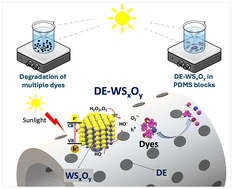
This study presents the fabrication of tungsten oxide–tungsten disulfide, h-WO3/2H-WS2 (WSxOy), and its integration on the nanostructured diatomaceous earth (DE) microalgae surface to obtain a novel photocatalyst known as DE-h-WO3/2H-WS2 (DE-WSxOy) for the first time. It is significant to mention that the integration of WSxOy on the DE surface is directed toward enhancing the overall photocatalytic properties and performances. The developed novel photocatalyst is characterized using various techniques to study its morphological surface chemistry features, interface interactions and photochemical properties. The novelty of this study lies in the synthesis of a new photocatalyst integrated with microalgae, enabling rapid and high-performance solar-driven degradation. Importantly, through the support of the DE surface, the photocatalyst exhibits higher photocatalytic ability in aqueous phase reactions when compared with WSxOy alone, which could be due to synergistic effects such as higher adsorption properties, dispersibility, stability and more catalytic reaction sites. Furthermore, using rhodamine B (Rh B) as a model pollutant, the designed photocatalyst validated with 99.8% of decoloration efficiency was achieved. The prepared photocatalyst exhibits excellent photocatalytic degradation efficiency under various solution conditions for multiple dyes and mixed dye solutions, demonstrating its potential industrial significance. Besides, this work expanded towards investigating its photocatalytic reaction mechanisms and factors affecting photocatalytic activities. As a proof of concept/pioneering technology, the DE-WSxOy photocatalyst was integrated with PDMS in the form of easily adaptable discs to explore the real-time photodegradation of industrial wastewater (IWW), which can be regarded as next-generation photocatalyst development.
 Please wait while we load your content...


