


 PLATFORM UPDATE:


Microfluidic-assisted sperm sorter: a high-throughput sperm selection device

Abstract
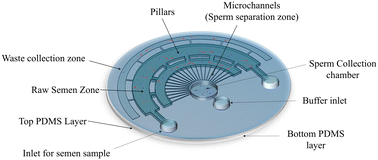
Infertility affects millions of people around the world, making it a significant health issue. The success of assisted reproductive techniques (ARTs) largely depends on the quality and method used for sperm cell selection. Conventional sperm selection methods bypass all natural selection barriers, hence leading to DNA damage, which can compromise clinical outcomes. In this study, we present a novel, cost-effective, two-layer microfluidic-assisted sperm sorting (MASS) device for high-throughput separation of motile sperm cells mimicking the natural sperm selection mechanism that occurs in the female reproductive tract. By employing varying flow rates, the device exploits sperm rheotaxis, the ability of sperm cells to swim against fluid flow, and boundary-following behaviour to guide motile sperm cells towards the collection chamber. Numerical simulations were conducted to analyze flow dynamics, including velocity profiles and shear rate distribution, in order to optimize conditions for sperm rheotaxis. Biological assays were performed to check the viability and DNA fragmentation of separated sperm cells. The device is capable of isolating over 2.5 million motile sperm cells per ml from a 500 μL semen sample within 20 minutes, achieving an isolation efficiency of 8.1%, with a motility of 98.83%, a viability of 98.2%, and a DNA fragmentation of 2.84%. In comparison, raw semen samples exhibited motility, viability, and DNA fragmentation values of 49.5%, 52.4%, and 19%, respectively, while the swim-up method exhibited 79.17%, 81.3%, and 11.2%, respectively. Thus, the MASS device provides a sufficient number of high-quality sperm cells for IVF and ICSI procedures and serves as a versatile tool for studying micro swimmer dynamics and the fundamental mechanisms of sperm rheotaxis.
 Please wait while we load your content...


