



Rapid identification of spent lithium-ion battery black powder types using handheld LIBS and interpretable MobileNet models
 *a
*a
Abstract
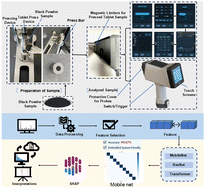
The black powder obtained by mechanically crushing and screening spent lithium-ion batteries serves as the primary raw material for the lithium-ion battery recycling industry. Rapid and accurate identification of different types of lithium-ion battery black powder is crucial for assessing their value and selecting appropriate recycling processes. This study employed handheld laser-induced breakdown spectroscopy (LIBS) to collect spectral data from nine common types of lithium-ion battery black powder and evaluate the effectiveness of three data preprocessing methods, standard normal variable transformation (SNV), extended multiplicative scattering correction (EMSC), and Savitzky–Golay (SG) filtering, to improve spectral data quality. Subsequently, a lightweight MobileNet model suitable for embedded systems was developed for identifying and predicting the nine common categories of lithium-ion battery black powder, and its performance was compared with that of mainstream Residual Network (ResNet) and Transformer deep learning models. Ultimately, SHapley Additive exPlanations (SHAP) analysis was employed to evaluate the potential contribution of different input feature wavelengths to the prediction results, providing clear explanations for the decisions made by the model. The results demonstrate that MobileNet achieves accurate black powder classification while maintaining embedded system compatibility, with an average recognition accuracy of 99.67%. The proposed method exhibits significant application potential in the circular economy of the lithium-ion battery industry.
 Please wait while we load your content...


