


 PLATFORM UPDATE:


Regulating interfacial proton transfer via Mo-induced hydrated K+-H2O networks in CoP@CoMoO4 heterojunction for enhanced alkaline hydrogen evolution
 a
Huaqiang
Chu
*a
and
a
Huaqiang
Chu
*a
and
Abstract
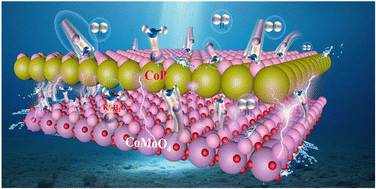
While transition metal phosphides (TMPs) such as CoP show promising intrinsic activity for the hydrogen evolution reaction (HER), their performance in alkaline media is often hampered by the high energy barrier for water dissociation and insufficient proton supply. Recent advances highlight that enriching the proportion of cationic hydrated water (K+-H2O) at the catalyst interface can effectively soften the interfacial hydrogen-bond network and accelerate water migration, offering a promising strategy to enhance HER kinetics and overcome the challenges in TMPs. Herein, we deliberately engineered a CoP@CoMoO4 heterojunction catalyst aimed at elevating the local concentration of K+-H2O near the active CoP sites. Operando surface-enhanced infrared absorption spectroscopy directly confirms a significant rise in K+-H2O at the heterointerface under working conditions. Density functional theory calculations further reveal that the heterointerface induces favorable electronic reconstruction and modulates the coordination environment, while Mo sites guide the transport of protons from interfacial water via K+-H2O complexes to adjacent Co active centers. This targeted interfacial restructuring enables the CoP@CoMoO4 catalyst to achieve an overpotential of only 59 mV at the current density of 10 mA cm−2 and a low Tafel slope of 43 mV dec−1 in 1 M KOH. Our work not only confirms that increasing K+-H2O population is an effective design principle for alkaline HER catalysts, but also provides a mechanistic blueprint for engineering efficient heterointerfaces through interfacial water control.
 Please wait while we load your content...


