


 PLATFORM UPDATE:


Advanced sodium-ion battery anode material prepared by regulating an environmentally friendly hard carbon precursor through bio-based molecular coupling
 *a
*a
Abstract
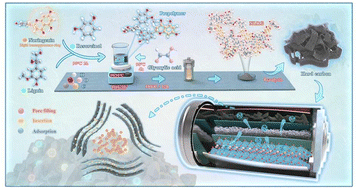
Phenolic resin (PF) is considered a highly promising precursor for hard-carbon anodes in sodium-ion batteries. However, its toxicity and disordered structure introduce environmental concerns and restrict sodium-storage performance. To address this issue, a dual-innovation strategy in both material and structure was proposed in this work. By coupling the rigid benzopyrone ring from natural naringenin with the three-dimensional network of lignin and employing the green aldehyde source glyoxylic acid as cross-linking agent, an environmentally friendly bio-based phenolic resin precursor (NLRG) was constructed, achieving complete substitution of toxic phenol and formaldehyde. Through the regulation of pyrolysis temperature, 1400 °C was identified as the critical condition for forming an ideal disordered structure. The resulting material exhibits a suitable interlayer spacing, abundant defects and nanopores, together with moderately developed graphitic microcrystals. Benefiting from this, it delivers high reversible capacity of 356.2 mAh g−1 and initial coulombic efficiency of 84.2% in half-cell tests. After 1000 cycles at 2000 mA g−1, a capacity retention rate of 90.5% is maintained. When assembled into a full cell with an O3-NaNi1/3Fe1/3Mn1/3O2 cathode, the energy density of 241 Wh kg−1 is achieved, and the capacity retention remains 70.3% after 310 cycles. The comprehensive characterizations reveal stepwise sodium-storage mechanism described as “adsorption – insertion – insertion & pore filling – pore filling”. This study not only provides a green preparation route for high-performance hard carbon, but the elucidated strategy for regulating the micro-disordered structure also offers new insights for the design of future carbon-based energy-storage materials.
 Please wait while we load your content...


