


 PLATFORM UPDATE:


Mechanical force-induced proton transfer promotes the selective extraction of spent lithium iron phosphate
 abcd
and
Li
Li
*abcd
abcd
and
Li
Li
*abcd
Abstract
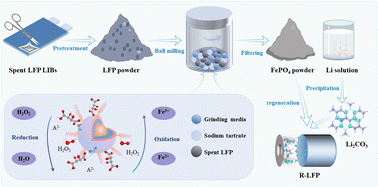
Recycling spent lithium-ion batteries is a crucial link in promoting the development of a clean energy circular economy. However, traditional pyrometallurgical methods are energy-intensive and complex, making it difficult to economically recycle LiFePO4 (LFP). Herein, we propose a mechanical force-induced proton transfer and oxidation coupling synergy strategy for the selective extraction of lithium from spent LFP materials. This method employs low-cost and environmentally friendly sodium tartrate and hydrogen peroxide (H2O2) as co-grinding reagents. A dual reaction mechanism is synergistically triggered under mechanical force: mechanical activation promotes the proton dissociation of sodium tartrate hydroxyl groups, facilitating proton-assisted delithiation; simultaneously, H2O2in situ oxidizes Fe2+ to Fe3+, driving the topological conversion of LFP into FePO4, thereby efficiently extracting lithium while stabilizing iron in the solid phase. Under optimized conditions, the lithium leaching efficiency reaches 99.2%, and 95.2% of iron is enriched in the residue as high-purity FePO4. Compared with traditional hydrometallurgical recycling, the proposed route reduces greenhouse gas emissions by 17% and lowers overall processing costs to 82%. Moreover, the resulting lithium-rich solution and Fe-containing residue can serve as precursors for regenerating LFP cathode materials. The regenerated LFP exhibits excellent cycling performance, with a capacity retention of 97.3% after 100 cycles at 1C. Therefore, this study develops a green, economical, and high-value recycling pathway for spent LFP batteries. This approach embodies the recycling principles of atom economy and process greening, providing a practical and feasible technical solution for the sustainable regeneration of spent LFP batteries.
 Please wait while we load your content...


