


From waste to wealth: upcycling spent LiCoO2 batteries into a high-performance Co3O4-graphene modified diaphragm for lithium–sulfur batteries
 *b
*b
Abstract
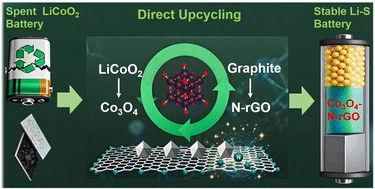
The practical deployment of lithium–sulfur (Li–S) batteries is severely hampered by the polysulfide shuttle effect, significant volume changes during sulfur conversion reactions, and dendrite growth on the Li anode. While modifying diaphragms with polar materials like Co3O4 offers a promising solution, their conventional synthesis relies on costly virgin materials and complex processes, raising economic and environmental concerns. Concurrently, the escalating pile of spent lithium-ion batteries (LIBs) presents a critical waste challenge. Hence, a sustainable “waste-to-wealth” strategy is proposed to address both issues simultaneously through the upcycling of spent LiCoO2 (LCO) batteries into a high-value Co3O4-N-doped reduced graphene oxide (Co3O4-rGO) composite, which is employed as a multifunctional diaphragm modifier. The Co3O4 nanoparticles, derived from the spent cathode, are designed to anchor and convert lithium polysulfides (LiPSs), while the N-doped rGO, regenerated from the discarded anode, provides a conductive network and facilitates Li+ transport. This synergistic effect effectively suppresses the polysulfide shuttle, accelerates reaction kinetics, and promotes uniform lithium deposition. Consequently, Li–S batteries equipped with the Co3O4-rGO-0.5 modified diaphragm exhibit exceptional cycling stability and rate capability, retaining a high capacity of 502.9 mAh g−1 after 600 cycles at 3C with an ultra-low capacity decay rate of 0.0437% per cycle, markedly outperforming batteries with conventional diaphragms. This work establishes a scalable, eco-friendly protocol for repurposing battery waste into advanced materials, paving the way for the development of sustainable energy storage systems.
 Please wait while we load your content...


