


 PLATFORM UPDATE:


Sustainable production of high-energy-density fuels with natural terpenes and phenols
 *a
Jing-Pei
Cao
*a
*a
Jing-Pei
Cao
*a
Abstract
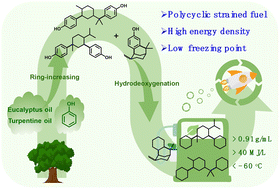
High-energy-density (HED) fuels can enhance the payload and range performance of aircraft, holding strategic importance in the field of air defense. However, conventional petroleum-derived HED fuels face growing challenges related to resource depletion and greenhouse gas emissions. In response to the urgent need for sustainable alternatives, we developed an efficient ring-increasing strategy using natural terpenes as feedstocks to construct polycyclic frameworks suitable for HED fuel applications. The process includes acid-catalyzed ring-increasing alkylation of renewable terpenes with phenols and subsequent hydrodeoxygenation over a bifunctional Pd/C and H-Y catalyst system. Benefiting from their strained and polycyclic architectures, the eucalyptus oil-derived biofuel exhibited a density of 0.914 g mL−1, combustion heat of 40.1 MJ L−1, freezing point below −67 °C and viscosity of 34.5 cSt, while the turpentine oil-derived fuel achieved even higher energy density. The high density and good low-temperature fluidity render these fuels as promising sustainable alternatives to conventional petroleum-based HED fuels.
 Please wait while we load your content...


