


 PLATFORM UPDATE:


Solid-state interrupted chemical reaction-based tri-phase design of the FeMoO4/CuFe2S3/CuSe2 electrocatalyst for enhancing electrochemical nitrogen reduction

Abstract
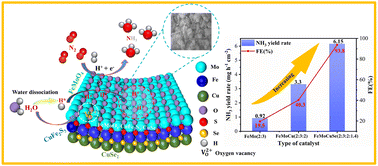
The electrochemical nitrogen reduction reaction (N2RR) to ammonia (NH3) is a sustainable and eco-friendly approach that can help restore the disrupted nitrogen cycle and address environmental challenges. However, achieving selective NH3 synthesis is challenging due to the complex nitrogen reduction process, competition from the hydrogen evolution reaction (HER), the strong N![[triple bond, length as m-dash]](https://www.rsc.org/images/entities/char_e002.gif) N triple bond, and the low solubility of N2 in water. Therefore, the design and development of highly efficient N2RR catalysts are crucial for industry and the environment. This study presents a tri-phase FeMoO4/CuFe2S3/CuSe2 system, synthesized via a solid-state interrupted reaction, as a highly efficient electrocatalyst for the N2RR. The optimized catalyst exhibits an impressive faradaic efficiency of 93.8% and a high ammonia yield of 6.15 mg h−1 cm−2 at −0.6 V vs. RHE. When implemented in a stack cell with an Fe(MoO4)/CuFe2S3/CuSe2 cathode and a NiFeV anode, the system achieves an NH3 yield rate of 2.09 mg h−1 cm−2 at 2.0 V, with an FE of 50.9%, while maintaining a low energy consumption of 18.58 kWh kg−1. Collectively, these results outperform most reported transition metal-based catalysts, highlighting the effectiveness of rational catalyst design and its strong potential for practical electrochemical ammonia synthesis. A time-dependent 15N2-labeling experiment confirmed that the produced NH3 originated solely from the supplied 15N2, excluding contamination. The enhanced performance of the FeMoO4/CuFe2S3/CuSe2 electrocatalyst is attributed to oxygen vacancies and variable oxidation states, which are induced by incorporating selenium and copper into the catalyst system. The trapping of inert N2 is enhanced by oxygen vacancy-mediated polarization, metal-site vacancies, and interfacial effects between catalyst phases. This study presents a versatile approach for designing catalysts that enhance electrocatalytic methods for ammonia (NH3) production through electrochemical nitrogen reduction.
N triple bond, and the low solubility of N2 in water. Therefore, the design and development of highly efficient N2RR catalysts are crucial for industry and the environment. This study presents a tri-phase FeMoO4/CuFe2S3/CuSe2 system, synthesized via a solid-state interrupted reaction, as a highly efficient electrocatalyst for the N2RR. The optimized catalyst exhibits an impressive faradaic efficiency of 93.8% and a high ammonia yield of 6.15 mg h−1 cm−2 at −0.6 V vs. RHE. When implemented in a stack cell with an Fe(MoO4)/CuFe2S3/CuSe2 cathode and a NiFeV anode, the system achieves an NH3 yield rate of 2.09 mg h−1 cm−2 at 2.0 V, with an FE of 50.9%, while maintaining a low energy consumption of 18.58 kWh kg−1. Collectively, these results outperform most reported transition metal-based catalysts, highlighting the effectiveness of rational catalyst design and its strong potential for practical electrochemical ammonia synthesis. A time-dependent 15N2-labeling experiment confirmed that the produced NH3 originated solely from the supplied 15N2, excluding contamination. The enhanced performance of the FeMoO4/CuFe2S3/CuSe2 electrocatalyst is attributed to oxygen vacancies and variable oxidation states, which are induced by incorporating selenium and copper into the catalyst system. The trapping of inert N2 is enhanced by oxygen vacancy-mediated polarization, metal-site vacancies, and interfacial effects between catalyst phases. This study presents a versatile approach for designing catalysts that enhance electrocatalytic methods for ammonia (NH3) production through electrochemical nitrogen reduction.
 Please wait while we load your content...


