


 PLATFORM UPDATE:


Kosmotropic-effect-driven biphasic aqueous electrolyte towards durable zinc-ion batteries
 *a
and
Fei
Lu
*a
*a
and
Fei
Lu
*a
Abstract
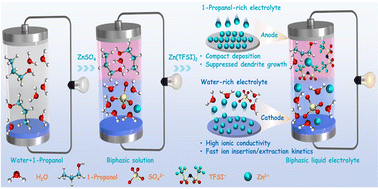
Conventional electrolytes for aqueous zinc-ion batteries (AZIBs) focus on inhibiting water activity to stabilize the Zn anode, but always at the expense of ion transport, resulting in failing to simultaneously meet the demands of both cathode and anode. Here, we propose a facile aqueous/organic biphasic liquid electrolyte (BLE) design strategy based on the kosmotropic effect. Although water and 1-propanol are inherently miscible, the kosmotropic effect of sulfate ions (SO42−) with high charge density induces strong intermolecular interactions among the electrolyte components, thereby achieving precise modulation of phase behavior through anion-specific thermodynamic control. In the as-developed BLE, which comprises two distinct electrochemical reaction chambers, the anode-customized 1-propanol-rich electrolyte (OE) simultaneously suppresses water-triggered parasitic reactions and facilitates homogeneous Zn deposition, achieving an optimal average coulombic efficiency of 99.1% over 200 cycles and an extended lifespan of more than 6800 h. The cathode-customized water-rich electrolyte (AE) delivers excellent ionic conductivity (39.2 mS cm−1) and synergistically modifies cathode/electrolyte interfaces via residual organic additives, thereby facilitating rapid Zn2+ insertion/extraction kinetics. The study provides a promising perspective for the structural optimization of electrolytes to fulfill the unique requirements of both electrodes for advanced ultra-long-life AZIBs.
 Please wait while we load your content...


