


Expanding COF layer stacking distances for enhanced photocatalytic activity
 a
and
Hong-Xi
Li
*a
a
and
Hong-Xi
Li
*a
Abstract
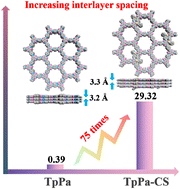
Covalent organic frameworks (COFs) hold promise for photocatalytic applications but suffer from suppressed charge separation due to Frenkel exciton formation and detrimental interlayer coupling. To address this issue, we have investigated a thiourea group-mediated interlayer-spacing engineering strategy. The reaction of 1,3,5-triformylphloroglucinol and p-phenylenediamine in the presence of PhNCS gave a thiourea-functionalized COF, TpPa-CS. The in situ formed thiourea groups were distributed within the layers, enlarging interlayer distances via steric defects. The average layer stacking distance of TpPa-CS was 3.30 Å, which is larger than that of TpPa (3.22 Å). The hydrogen evolution rate of Ni2+-modified TpPa-CS (TpPa-CS-Ni) was 29.32 mmol g−1 h−1, representing enhancements 75.2 and 5.6 times those of the parent TpPa and TpPa-Ni (i.e. Ni-loaded TpPa), respectively. This design simultaneously suppressed interlayer charge transfer and enhanced intramolecular charge transfer. Photoelectrochemical testing confirmed efficient synergy between the sulfur ligands and metal ions, leading to improved charge carrier separation. Theoretical and experimental analyses confirmed that electron-donating/accepting moieties in TpPa-CS optimized HOMO/LUMO levels, enabling efficient metal coordination at S/N sites to form electron-transfer catalytic centers. This work provides a novel approach to engineering interlayer interactions for high-performance COF photocatalysts.
 Please wait while we load your content...


