


 PLATFORM UPDATE:


Ligand–metal synergy in MOF-derived Co–Ni(TCNQ)2·2H2O for efficient HMF electrooxidation and hydrogen Co-production
 *ad
and
Changlun
Chen
*b
*ad
and
Changlun
Chen
*b
Abstract
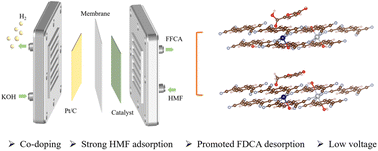
The electrocatalytic oxidation of 5-hydroxymethylfurfural (HMF) coupled with hydrogen evolution offers a sustainable approach for producing value-added chemicals and green hydrogen. Achieving both high current densities and long-term operational stability remains a significant challenge. A metal–organic framework (MOF)-structured Co–Ni(TCNQ)2·2H2O nanorod-array catalyst demonstrates exceptional activity and durability for HMF electrooxidation. This bimetallic framework achieves high current density up to 1000 mA cm−2, requiring only 1.72 V in 1.0 M KOH with 200 mM HMF, which significantly outperforms Ni(TCNQ)2·2H2O and highlights the strong promoting effect of cobalt incorporation. Nearly complete HMF conversion and high selectivity for 2,5-furandicarboxylic acid (FDCA) are observed, along with excellent recyclability under concentrated substrate conditions. Operando and ex situ analyses indicate that cobalt doping mitigates over-oxidation and the associated irreversible structural transformation of the nickel sites stabilizes a dynamic Ni2+/Ni3+ redox cycle, and enhances charge delocalization through the TCNQ ligand. These effects collectively prevent over-oxidation and ensure sustained catalytic turnover. Density functional theory calculations confirm that cobalt strengthens HMF adsorption and facilitates FDCA desorption, thereby coupling efficient substrate activation with effective product release. This dual thermodynamic modulation explains the reduced onset potential and increased current density. Thus, Co–Ni(TCNQ)2·2H2O serves as a robust, selective, and scalable electrocatalyst, linking mechanistic understanding to industrial-scale biomass upgrading and simultaneous hydrogen generation.
 Please wait while we load your content...


