


Design and engineering of biosynthetic and regeneration pathways for central sulfate donors: toward the sustainable production of bioactive sulfated products
 d
Zhen
Kang
*abc
d
Zhen
Kang
*abc
Abstract
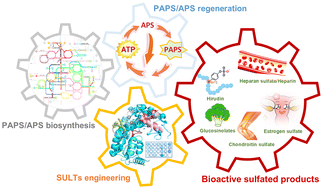
3′-Phosphoadenosine-5′-phosphosulfate (PAPS) and its precursor adenosine 5′-phosphosulfate (APS) are universal sulfate donors that underpin diverse sulfonation reactions and play pivotal roles in sulfur metabolism. As the central activated forms of sulfur, they serve as intermediates in the assimilation of inorganic sulfate into organic biomolecules and provide sulfonate groups for the structural diversification of natural products, glycosaminoglycans, and secondary metabolites. Recent advances have revealed new insights into their biosynthetic routes, regulatory mechanisms, and enzymatic systems, along with innovative strategies for their regeneration and application. Progress in metabolic engineering has enabled efficient PAPS/APS supply and recycling, while high-throughput sulfotransferase screening, structure-guided protein engineering, and rational synthetic pathway design have expanded the toolkit for tailoring sulfonation patterns with enhanced specificity and catalytic performance. In this review, we critically summarize advances in PAPS/APS biosynthesis, highlight emerging approaches for synthetic pathway design and sulfotransferase discovery, and discuss their implications for the sustainable biomanufacturing of sulfated natural products. Particular emphasis is placed on the convergence of synthetic biology, enzyme engineering, and systems-level metabolic design, which together offer powerful opportunities to expand the chemical space of sulfated compounds. These developments not only deepen our understanding of sulfur assimilation and its regulation but also open new prospects for engineering sulfation pathways toward the scalable, green, and economically viable production of high-value sulfated metabolites.
 Please wait while we load your content...


