


A simple self-corrosion method constructs a Ni3S2@FeOOH heterostructure enabling industrialized seawater oxidation
 *b
Hui
Tang
*a
*b
Hui
Tang
*a
Abstract
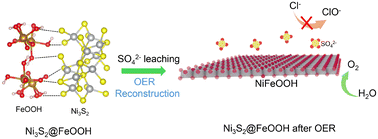
Electrocatalytic seawater splitting shows immense promise as a green hydrogen production technology; however, the anodic oxygen evolution reaction (OER) confronts formidable challenges arising from the high concentration of chloride ions (Cl−) and other impurities in seawater. Herein, we develop a facile two-step immersion corrosion strategy to successfully construct a Ni3S2@FeOOH/NF heterojunction electrocatalyst on nickel foam (NF) tailored for industrial alkaline seawater oxidation. Integrating density functional theory (DFT) calculations and experimental characterization, we demonstrate that Ni3S2@FeOOH/NF selectively enriches OH− while repelling Cl− during the OER in alkaline seawater electrolytes. Notably, in situ leaching of SO42− from the electrode triggers efficient self-reconstruction, facilitating the generation of high-valence metal active sites. The as-fabricated catalyst exhibits remarkable OER performance with a low overpotential of 390.5 mV at 1000 mA cm−2 in alkaline seawater. Moreover, it maintains exceptional electrochemical stability for over 1000 hours at an industrial current density of 1000 mA cm−2. This work provides a scalable strategy for constructing self-reconstructing electrocatalysts that promote high-valence metal site formation and efficient Cl− repulsion in alkaline seawater oxidation (ASO).
 Please wait while we load your content...


