


Low-temperature synthesis of red carbon dots with precise spectral conversion via a microwave–solvothermal method and application in spectral conversion films
 *a
*a
Abstract
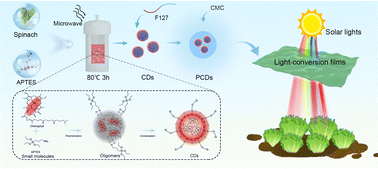
Carbon dots (CDs) are considered effective nanomaterials for photoconversion because of their distinct physical and optical characteristics, especially their ability to reduce aggregation-caused quenching (ACQ). The hydrothermal/solvothermal method is the preferred approach for synthesizing CDs. However, it typically requires high reaction temperatures and extended reaction times, which hinder the industrialization of CD production. In this study, a novel microwave–solvothermal combined method was employed to design and synthesize a series of solid-state luminescent CDs that precisely match the absorption spectrum of chlorophyll. Unlike traditional hydrothermal/solvothermal methods that necessitate higher temperatures and longer durations, this approach allows for the synthesis of solid-state luminescent CDs even at 60 °C for 3 h. Surface modification of the CDs with polymer coatings yielded cross-linked polymer CDs (PCDs), which effectively suppressed the ACQ. Utilizing the hydrophilicity of PCDs, a spectral conversion film (PCDs/CMC-Al3+) was designed and prepared using carboxymethyl cellulose (CMC) as the matrix and Al3+ as the green binder. This film precisely adjusts the solar spectrum, converting ultraviolet and blue light into red light that aligns with the chlorophyll spectrum, thereby increasing the photon flux density in the red band by 7.8%. Plant growth experiments demonstrated that PCDs/CMC-Al3+ can passively enhance photosynthesis in green leaf lettuce, with fresh and dry weights increasing by 25.79% and 23.30%, respectively, highlighting its significant potential in agricultural spectral conversion applications.
 Please wait while we load your content...


