


 PLATFORM UPDATE:


Mechanistic insights into hydrogen-enhanced sulfidation of smithsonite via fluidization roasting
 abc
Yongsheng
Sun,
*abc
abc
Yongsheng
Sun,
*abc
Abstract
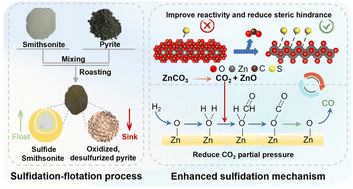
The selective and sustainable extraction of zinc oxide ores has attracted significant attention, but it remains an unresolved challenge. Sulfidation roasting offers a promising method, provided that energy consumption and pollutant emissions can be effectively minimized. In this study, we propose a fluidization roasting process that utilizes hydrogen (H2) to enhance the sulfidation of smithsonite, achieving notable improvements in both energy efficiency and emission reduction. After sulfidation, the sulfide layer on the smithsonite surface shows strong mechanical stability, with the surface contact angle increasing to 42.3°, and a recovery of 89.81 wt% was achieved using butyl xanthate (BX) as a collector. In contrast, pyrite becomes hydrophilic due to oxidation during the roasting process. An in-depth analysis reveals that zinc oxide generated from the pyrolysis of smithsonite catalyzes the reduction of CO2 to CO by H2, thereby lowering the partial pressure of CO2 and driving the decomposition of smithsonite. Zinc oxide exhibits stronger reactivity and lower steric hindrance, facilitating its reaction with the sulfidizing agent. The H2-enhanced sulfidation process introduced in this study provides a novel approach for the selective separation of zinc oxide resources and offers valuable insights for scaling up to industrial applications.
 Please wait while we load your content...


