


Carbonyl-functionalized metallic ionic liquids via coordination for efficient hydrogen sulfide separation and conversion using α,β-unsaturated carboxylate esters
 *a
*a
Abstract
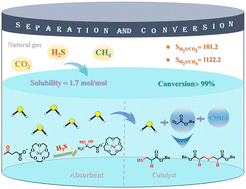
The efficient capture and conversion of hydrogen sulfide (H2S) represent a critical challenge in addressing key issues in energy and environmental fields. In this study, we innovatively designed and synthesized a series of carbonyl-functionalized metallic ionic liquids (CMILs), which exhibit dual functionality as both absorbents and catalysts under mild conditions. Experimental results demonstrate that the [Na-15C][LA] system delivers outstanding performance under ambient conditions (30 °C, 1.0 bar), achieving an H2S absorption capacity of 1.73 mol mol−1, an H2S/CO2 selectivity of 101.2, and an exceptionally high H2S/CH4 selectivity of 1122.2. NMR, FT-IR, and DFT calculations confirm that the carbonyl group serves as the active site for efficient H2S capture. Notably, these CMILs function as highly effective catalysts, facilitating the solvent-free conversion of H2S with α,β-unsaturated carboxylates into thiols and thioethers under mild conditions. Moreover, the system enables spontaneous phase separation between the catalyst and products without requiring additional components, achieving quantitative conversion (>99%) while adhering to green chemistry principles. This integrated design provides a novel technical approach for the efficient capture and resource utilization of H2S.
 Please wait while we load your content...


