


 PLATFORM UPDATE:

Electrochemical regeneration of amine-based CO2 capture systems: a study on CO2 desorption efficiency

Abstract
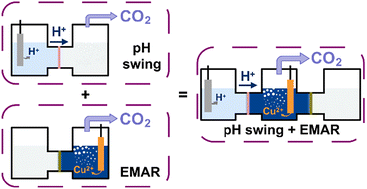
Electrochemically mediated amine regeneration (EMAR) offers an energy-efficient alternative to thermal CO2 desorption, yet most studies employ toxic amines such as ethylenediamine (EDA). In this work, an EMAR system based on monoethanolamine (MEA)—a mild, non-toxic, and industrially relevant amine—was systematically investigated. The electrochemical behavior of copper in MEA was examined and compared with alkaline solutions without amine, revealing the formation of multiple stable Cu–MEA complexes. E–pH and speciation diagrams were constructed to identify operating windows that maximize Cu(II) solubility while avoiding hydroxide precipitation. Key process parameters, including applied current, additives, and temperature, were evaluated to optimize CO2 desorption efficiency and, consequently, the stability/operability limits of the Cu–MEA system have been identified. The full EMAR loop—combining Cu electrodissolution at the anode with Cu electrodeposition at the cathode—operated with 100% faradaic efficiency for Cu dissolution while maintaining CO2 desorption performance. A novel three-compartment cell enabling simultaneous Cu electrodissolution and electrochemical acidification was also tested. Contrary to expectations, combining both approaches did not outperform pure Cu electrodissolution, the most efficient mode. Yet, combined electrodissolution and electrochemical acidification achieved a high faradaic efficiency of ca. 90%. These results establish optimal conditions for MEA-based EMAR and provide guidance for its integration into continuous CO2 capture systems.
- This article is part of the themed collection: International Symposium on Green Chemistry 2025
 Please wait while we load your content...


