



A powerful three-dimensional C–F–Bi cathode for Zn–CO2 batteries

Abstract
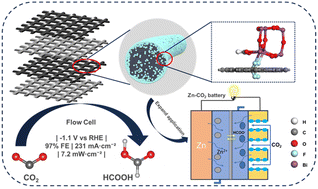
Mars could be the second home for humans but obtaining reliable energy is the primary issue that needs to be addressed. Metal–CO2 batteries are considered a reliable method because the concentration of CO2 in the Martian atmosphere exceeds 95%. Herein, we developed a three-dimensional self-supporting electrode fabricated using Bi2O3 composites and F-doped carbon fibers, in which the fluorine element, as an atom-bridge, was applied to construct a novel C–F–Bi active site to strengthen the interaction between C and Bi by orbital hybridization. This electrode was directly used as a cathode for Zn–CO2 batteries. The strong electron-withdrawing effect of F allowed Bi to maintain a positive charge at negative potentials, thus endowing the bismuth active sites with both high activity and stability during CO2 electroreduction. Remarkably, this cathode achieved a high faradaic efficiency of 97% towards formate with a high current density of −231 mA cm−2 under a low potential of −1.1 V vs. RHE and offered a high-power density of 7.2 mW cm−2 in the Zn–CO2 battery. The self-supported C–F–Bi cathode, without any adhesives and ionomers, may bring a new era of Mars batteries.
 Please wait while we load your content...


