


 PLATFORM UPDATE:


Sb2S3@carboxyl-modified COF S-scheme heterojunctions: the Sb–O–C interface enhances photocatalytic CO2 reduction performance
 a
Qingrong
Cheng
*a
a
Qingrong
Cheng
*a
Abstract
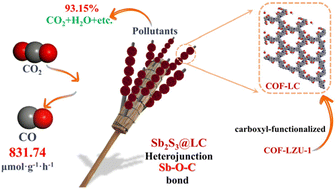
The construction of S-scheme heterojunctions can greatly improve the catalytic performance of photocatalysts. In this study, LZU-1 was carboxylated and then combined with Sb2S3 to construct an S-scheme Sb2S3@COF-LC(SSLC) heterojunction with excellent photocatalytic properties, in which the H atom on the carboxyl group is substituted by Sb to form a stable Sb–O–C bond. COF-LC contains a specific quantity of nucleophilic carboxyl groups that enhance the availability of effective active sites, and the enhanced interfacial contact stability between Sb2S3 and COF-LC greatly improves the charge transfer efficiency. Under the synergistic action of multiple free radicals, Sb2S3@COF-LC-2 showed photocatalytic degradation of different pollutants (MB and MO), and the degradation rates reached 93.15% and 94.52%, respectively. It is worth mentioning that the CO formation rate is as high as 831.74 μmol g−1 h−1, and the Sb2S3@COF-LC-2 heterojunction has good cycling stability. Additionally, density functional theory (DFT) analyses reveal the charge-transfer mechanism of the S-scheme heterojunction. In this study, the interfacial photocarrier transfer and space charge separation of antimony-based heterojunctions were promoted by post-treatment of COF LZU-1 and substitution of hydrogen atoms on carboxyl groups with metal elements, which has the potential to be extended to the construction of other heterojunction photocatalysts.
 Please wait while we load your content...


