Peng
Chen
*a,
Ming
Zou†
a,
Yu
Zhang†
a,
Niuniu
Li
a,
Ruoqi
Li
a,
Lijuan
Liang
a,
Zhenguo
Zhang
a,
Teck-Peng
Loh
*ab and
Zhenhua
Jia
*ac
aHenan Linker Technology Key Laboratory, College of Advanced Interdisciplinary Science and Technology (CAIST), Henan University of Technology, Zhengzhou 450001, China. E-mail: caist_chenpeng@haut.edu.cn; caist_zhjia@haut.edu.cn; teckpeng@ntu.edu.sg
bDivision of Chemistry and Biological Chemistry, School of Chemistry Chemical Engineering, and Biotechnology, Nanyang Technological University, Singapore 637371, Singapore. E-mail: teckpeng@ntu.edu.sg
cDepartment of Chemistry, Fudan University, Shanghai, 200433, China
First published on 3rd December 2025
Dithioacetals are essential building blocks in organic synthesis, materials development, and drug discovery. Despite their utility, existing synthetic methods often depend on organic solvents and transition metal catalysis under harsh conditions, limiting their sustainability and biological compatibility. In this work, we present an ultrafast, triaryl carbenium ion-pair-catalyzed thiol-acetalization protocol in water. Using a variety of aldehydes, ketones and isatins with thiols as coupling partners, the reaction proceeds under mild, metal-free conditions to deliver thioacetals in excellent yields (up to 99%) and with broad substrate scope. The method tolerates diverse functional groups and enables late-stage functionalization of natural products, amino acid derivatives, and small-molecule drugs. Moreover, the thiol-acetalization proceeded efficiently with catalyst loadings as low as 1.0 mol% and was scalable to a gram level. Furthermore, the biocompatibility, mild conditions, and rapid features make this approach well-suited for potential use in bioconjugation and biomolecule derivatization.
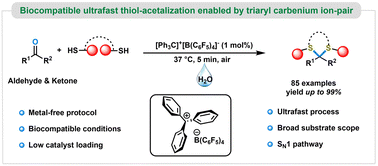
Green foundation1. In this study, we present an ultrafast, triaryl carbenium ion-pair-catalyzed thiol-acetalization protocol in water under metal-free conditions.2. This thiol-acetalization proceeded efficiently with catalyst loadings as low as 1.0 mol% and was scalable to a gram level. Furthermore, the biocompatibility, mild conditions, and rapid features make this approach well-suited for potential use in bioconjugation and biomolecule derivatization. 3. This study offers a promising green alternative for constructing thioacetals with high efficiency and environmental compatibility. |
In recent decades, significant progress has been made in developing sustainable methods for synthesizing dithioacetals. As shown in Fig. 1B, for instance, in 2013, the Connon group developed an efficient method for synthesizing dithiolane derivatives using Brønsted acidic imidazolium salts as catalysts at room temperature over 24 hours.26 In 2014, the Tang group pioneered an iron-catalyzed direct dithioacetalization of aldehydes with 2-chloro-1,3-dithiane to generate dithiolane derivatives.27 Additionally, photo-induced radical coupling reactions have emerged as efficient strategies for synthesizing dithioacetals under mild reaction conditions.28,29
Despite these advancements, current synthetic methods for dithioacetals predominantly rely on organic solvents. Consequently, the use of water as a reaction solvent is of substantial significance. For example, in 2002, the Kobayashi group developed a thiol-acetalization reaction in water in the presence of DBSA as a Brønsted acid surfactant combined with a catalyst.30 Recently, our group has also contributed to the development of forging disulfide bonds. In 2020, we reported 2H-azirines as potential bifunctional chemical linkers for cysteine residues.12 Subsequently, we developed a green and highly selective strategy to construct disulfide bridges in peptides using α,α-dichloro carbonyl compounds.13 In 2022, we disclosed the unique catalytic properties of triaryl carbenium ion pair mediated diverse organic transformations under metal-free conditions.31–37 Based on our previous work and recent research interest in bioconjugation,38–44 we here describe a highly efficient protocol for thiol-acetalization with aldoketones and thiols to achieve ultrafast synthesis of dithioacetals. This method employs triaryl carbenium ion pairs as catalysts under biocompatible conditions, utilizing water as a solvent with low catalyst loading. The reactions tolerate a broad range of functional groups and offer a more sustainable and efficient approach to dithioacetals (Fig. 1D).
| Entry | Deviation from standard conditions | Yield of 3 b (%) |
|---|---|---|
| a Standard conditions: 1a (0.2 mmol), 2a (0.42 mmol), [Ph3C]+[B(C6F5)4]− (1 mol%), H2O (2.0 mL) at 37 °C in air for 5 min. b NMR yields were determined by 1H NMR with CH2Br2 as an internal standard. c Isolated yield. n.d.: not detected. | ||
| 1 | None | 99 (98)c |
| 2 | Without [Ph3C]+[B(C6F5)4]− | n.d. |
| 3 | Na+[B(C6F5)4]− instead of [Ph3C]+[B(C6F5)4]− | 88 |
| 4 | K+[B(C6F5)4]− instead of [Ph3C]+[B(C6F5)4]− | 83 |
| 5 | [Ph3C]+[BF4]− instead of [Ph3C]+[B(C6F5)4]− | n.d. |
| 6 | B(C6F5)3 instead of [Ph3C]+[B(C6F5)4]− | 15 |
| 7 | [Ph3C]+[B(C6F5)4]− (0.5 mol%) | 88 |
| 8 | 3 min instead of 5 min | 85 |
| 9 | 1 min instead of 5 min | 64 |
| 10 | In argon | 98 |
With the optimal conditions in hand, we first explored the aldehyde scope for thiol-acetalization in water with benzyl thioalcohol 2a. The results are shown in Scheme 1. Gratifyingly, various aliphatic aldehydes, such as benzenepropanal and n-caproaldehyde, smoothly underwent this coupling reaction to generate the desired products 3 in 98% yield and 4 in 85% yield. When cyclopropyl-, cyclobutyl-, cyclopentyl- and cyclohexyl-carboxaldehydes were introduced as substrates, dithioacetals 5–8 were obtained in 66–88% yields. Subsequently, diverse substituted benzaldehydes were converted rapidly to their corresponding dithioacetals 9–32via triarylcarbenium ion-pair catalyzed thiol-acetalization in water. The substrates with electron-donating and electron-withdrawing groups at the para-position, such as methyl, tertiary butyl, methoxy, thiomethyl, phenyl, fluoride, chloride, bromide, iodide, cyano and trifluoromethyl groups, were successfully delivered into the corresponding products 10–20 in 69–99% yields. A better result was achieved with meta-position trifluoromethyl substitution (21). Further studies were conducted to evaluate the compatibilities of m-, and o-methyl groups on the benzene ring, leading to the synthesis of 22 and 23, respectively, in 94% and 99% yields. The aldehydes bearing alkene and alkyne groups performed smoothly under standard conditions, although 25 was obtained with a lower yield (77%). In addition, 26 was afforded with high yield, when the reaction was carried out by allowing 2-naphthaldehyde to react with 2a. To our delight, a sterically hindered aldehyde such as mesitaldehyde also gave the desired product 27 in 88% yield. Moreover, 28 was obtained in good yield, when the reaction was carried out with 2,4-difluorobenzaldehyde, which is relevant for potential bioactivity screening in medicinal chemistry. Substituents such as cyano and phenyl at the C5 position of the thiophene ring were tolerated to produce the desired products 29 in 99% yield and 30 in 89% yield. Heterocyclic aldehydes, for instance indole-3-carbaldehyde and ferrocenecarboxaldehyde, could be coupled with 2a to afford 31 in 67% yield and 32 in 99% yield. Moreover, aliphatic acyclic ketones and cyclic ketones, including 3-heptanone, cyclopentanone and cyclohexanone, were also converted to the corresponding products 33–35 in 76–90% yields. Furthermore, the reactions of 2-indanone and acetophenone with 1a proceeded smoothly to give the desired products 36 in 72% yield and 37 in 70% yield. Next, as shown in Scheme 1B, various 3,3-bis(benzylthio)indolin-2-ones were obtained with benzyl thioalcohol 2a and isatins at 100 °C for 1 h, which possess potential biological efficacies. Significantly, substrates substituted with methyl, methoxyl, nitro, chloride, bromide and fluoride groups at diverse positions were also well tolerated and showed good compatibility in water to generate the desired products in 45–94% yields (38–48). However, when the isatin bearing electron-withdrawing nitro group at the C7 position was examined, the yield of 49 decreased drastically (21%).
Subsequently, we further explored the applicability of this protocol by coupling different thiols 2 with hydrocinnamaldehyde 1a. As shown in Scheme 2, benzyl mercaptans with methyl on the ortho, meta, and para positions produced products 50–52 with excellent yields. para-Position substituents, including fluoride, chloride, bromide, methoxy and trifluoromethyl mercaptans, smoothly underwent this coupling reaction to generate the desired products 53–57 in 80–99% yields, respectively. Moreover, ethyl-, isopropyl- and tertiary butyl-mercaptans were all well-tolerated, generating products 58–60 with yields decreasing in that order (75–85% yields). Furthermore, 61 was also obtained with excellent yield and 62 was afforded in 97% yield with 1-heptanethiol. It was also uncovered that the sterically hindered 1-adamantyl mercaptan formed the corresponding product 63 in 84% yield. In addition, 64 was obtained in high yield when methyl 3-mercaptopropionate was utilized as the starting material. When 1,2-ethanedithiol and 1,3-propanedithiol were employed as substrates, the reactions were feasible to afford the desired products 65 in 55% yield and 66 in 56% yield. Moreover, heterocyclic ring substitutions such as furan and pyrazine resulted in moderate yields (67 and 68). Notably, using thiophenol as the substrate, the coupling product 69 was obtained in 86% yield. In addition, para-substituted aryl thiols with –Me, –OMe, –tBu, –F, Cl−, –Br, and –CF3 groups and 2-naphthalenethiol were compatible to produce the products 70–77 in 69–99% yields. It is notable that halogen atoms and electron-withdrawing groups (–CF3) significantly suppressed the thiol-acetalization efficiency under standard conditions; however, in the presence of 5 mol% [Ph3C]+[B(C6F5)4]− at 37 °C for 30 min, the desired products 73–76 were also obtained in 75–88% yields.
To further showcase the versatility of this protocol with functional molecules containing aldehyde moieties, we coupled natural products and small molecular drugs with benzyl thioalcohol 2a. As shown in Scheme 3, we successfully obtained the desired products 78–81 in 64–72% yields under optimal conditions. L-Menthol was simply condensed with 4-formylbenzoic acid to produce the aldehyde, which reacted with 2a to produce the desired product 78 in 70% yield. Following the same strategy, we employed these natural products including helicid, galactose and estradiol derivatives as the substrates to afford the corresponding products 79–81 in 64–72% yields. Notably, with theophylline Impurity 1 as the substrate, the coupling product 82 was obtained in 33% yield in the presence of 5 mol% [Ph3C]+[B(C6F5)4]− as the catalyst at 37 °C for 12 hours, demonstrating the utility of this method for alkaloid modification. Furthermore, by slightly adjusting the reaction conditions, hydrocinnamaldehyde 1a reacted with various functional molecules containing thiol moieties to generate the desired products 83–87 in 32–86% yields at 37 °C with 5 mol% catalyst loading in 12 hours. For instance, for peptide derivatives, such as N-acetyl cysteine methyl ester, the corresponding product 83 was afforded in 42% yield. In addition, we employed the antihypertensive drug captopril derivative as the substrate to afford the corresponding product 84 in 32% yield. Subsequently, we employed a fluorescent molecule with a thiol tag, resulting in 85 in 54% yield. Additionally, the natural product gemfibrozil and naproxen derivatives bearing a thiol group were also utilized as substrates, furnishing the desired products 86 in 85% yield and 87 in 86% yield.
To demonstrate the synthetic utility of our work, we attempted to carry out the reaction at a scale of 2.0 grams, as shown in Scheme 4A. The scale-up reaction in approximately 5.2 grams provided the corresponding product 3 in satisfactory yield with hydrocinnamaldehyde 1a as the starting material (15 mmol). In order to gain a better mechanistic understanding of the thiol-acetalization in water, we carried out preliminary mechanistic studies. As a first investigation, in the absence of the ion-pair, thiol-acetalization was not observed (Scheme 4B, Blank). Subsequently, we used conventional Brønsted acids (1.0 equiv.), such as AcOH, HCl, H2SO4, TFA, TfOH and TsOH, as the catalyst instead of the catalytic amount of the [Ph3C]+[B(C6F5)4]− ion pair, and only minimal formation of the target product 3 was observed, which further illustrated the distinctive performance of the ion pair as the catalyst (Scheme 4B). In addition, a series of competitive experiments using para-substituted thiophenols were performed at 37 °C for 1 min, affording the target products 69, 70, 72, 73 and 75 (Scheme 4C).45,46 The Hammett plot (lg(kR/kH) versus σp) exhibited a linear correlation with a ρ value of −0.50 (R2 = 0.99), indicating that the observed acceleration by electron-donating substituents suggested that the rate-determining transition state involved partial cationic character at the sulfur-bound carbon. Furthermore, subsequently, the stability of the dithioacetals was evaluated (Scheme 4D). We exposed product 3 in buffer solutions with varying pH values from 2 to 10 or in the presence of H2O2 and fetal bovine serum (FBS). After stirring for 24 h, 3 demonstrated outstanding stability without experiencing significant degradation in buffer solutions, but 3 underwent a slight decomposition in FBS. Furthermore, we compared the 19F-NMR spectra of the samples shown in Scheme 4F. When 20 μL H2O was added to the solution of [Ph3C]+[B(C6F5)4]− in CDCl3, the new peaks were detected by 19F-NMR, indicating that the possible species such as H+[B(C6F5)4]− was likely generated in situ. Moreover, the chemical shift of the crude sample of the model reaction was obviously changed in 5 minutes, suggesting the formation of the possible carbenium ion intermediate. However, these alterations were not observed in 12 hours, probably due to the regeneration of the ion-pair catalyst (for more details, please see the SI).
Based on our previous works and preliminary studies,30,31 we proposed that H+[B(C6F5)4]− species was probably formed in situ, which was crucial for achieving the ultrafast carbonyl-thiol-acetalization in water. As shown in Scheme 5, the hydrolysis of the triaryl carbenium ion-pair initially occurred in water to form the hydrated (H2O)nH+[B(C6F5)4]− and the triphenyl methanol. In the presence of an aldehyde with benzyl thioalcohol 2a, the carbonyl group was activated by the in situ formed species to facilitate the following nucleophilic attack with one benzyl thioalcohol, producing the corresponding sulfonium ion intermediate I. Next, the carbenium ion intermediate II was formed through a proton transfer process followed by rapid dehydration. Subsequently, when the benzyl thioalcohol 2a was involved, an electrophilic substitution proceeded to produce the intermediate III. Finally, the dithioacetal product IV was afforded via deprotonation and the catalyst was simultaneously regenerated from the triphenyl methanol by a proton.
Footnote |
| † These authors contributed equally to this work. |
| This journal is © The Royal Society of Chemistry 2026 |