


 PLATFORM UPDATE:


Kaempferol alleviates right ventricular hypertrophy in high-altitude pulmonary hypertension rats by modulating the AMPK/ACC/CPT1B axis and the AMPK-mediated LDHA/PDHA1 pathway

Abstract
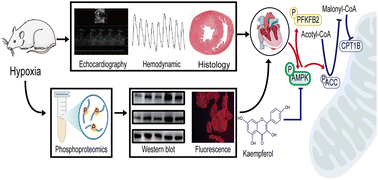
This study evaluates the protective effects of kaempferol on right ventricular (RV) structure and function in a rat model of high-altitude pulmonary hypertension (HAPH) and explores the underlying mechanisms. Male Sprague-Dawley rats (n = 57) were exposed to a simulated high-altitude environment (5000 m) for 28 days to induce HAPH, followed by the administration of kaempferol (25, 50, 100 mg kg−1 day−1) or sildenafil (30 mg kg−1 day−1). Echocardiography, hemodynamic measurements, and histopathological analyses revealed that kaempferol significantly reduced the RV/(LV + S) index, mean pulmonary artery pressure (mPAP), mean right ventricular systolic pressure (mRVSP), and RV free wall thickness (RVFWT); increased the pulmonary artery acceleration time (PAAT), PAAT/pulmonary artery ejection time (PAET) ratio, tricuspid annular plane systolic excursion (TAPSE), and RV-pulmonary artery coupling indices (TAPSE/mPAP and TAPSE/pulmonary artery systolic pressure [PASP]); and attenuated RV remodeling (assessed by H&E staining, Masson's trichrome staining, and transmission electron microscopy). Phosphoproteomic screening identified AMPK signaling as a key pathway modulated by kaempferol. In vivo, kaempferol downregulated the hypertrophy marker (MYH7B), suppressed the AMPK/ACC/CPT1B axis (at 25/50 mg kg−1), and reduced the LDHA (at 50/100 mg kg−1) and p-PDHA1 levels (at 25/50 mg kg−1) in RV tissues. Using the CCK-8 assay, fluorescence microscopy, and hypertrophy marker (BNP/MYH7B) detection, the optimal concentrations of Ang II (1 × 10⁻⁶ M) and kaempferol (40 μM) were selected. The effects of kaempferol on AMPK-mediated glucose and fatty acid oxidation were partially reversed by AICAR co-treatment, confirming the involvement of the AMPK pathway. Collectively, these findings demonstrate that kaempferol protects the RV structure and function and attenuates RV remodeling in HAPH rats, potentially through the modulation of the AMPK/ACC/CPT1B axis and the AMPK-mediated LDHA/PDHA1 pathway.
 Please wait while we load your content...


