Development and quality assessment of an antioxidant-rich Rubus squash: evaluation of physicochemical properties, bioactive compounds, and storage stability
Received
5th August 2025
, Accepted 13th October 2025
First published on 28th October 2025
Abstract
Rubus berries, particularly blackberries, are gaining global attention for their rich nutritional and bioactive value. These berries contain essential nutrients and polyphenols, contributing to their health promoting properties. As interest grows in wild edible species, Rubus fruits offer a promising approach to diversify diets. This study focused on developing a Rubus squash as a ready-to-serve beverage. Six squash samples were analyzed for physicochemical parameters, nutritional components, color parameters (L*, a*, and b* values), bioactive compounds, antioxidant activity, and sensory attributes. Specific bioactive compounds (3,4-DHBA, gallic acid, vanillic acid, rutin, quercetin and cyanidin-3-glucoside) were analyzed using HPLC. During storage, TSS, titratable acidity, total sugars and turbidity increased from 40 to 53.09 °Bx, 1.00 to 1.40%, 31.05 to 44.61%, and 947.16 to 1099.15 NTU, respectively, while, vitamin C, phenols, flavonoids, antioxidant activity and anthocyanins decreased, from 23.75 to 14.75 mg/100 mL, 524.03 to 294.53 mg GAE/100 mL, 223.69 to 124.22 mg QE/100 mL and 83.57 to 69.75 mg/100 mL among the treatments, respectively. The bioactive compounds also showed a decline during the storage period, ranging from 26.64 to 16.02 mg L−1, 90.23 to 59.94 mg L−1, 0.65 to 0.46 mg L−1, 4.15 to 3.03 mg L−1, 90.56 to 64.22 mg L−1 and 13.55 to 10.36 mg L−1, respectively, for 3–4 DHBA, gallic acid, vanillic acid, rutin, quercetin and cyanidin-3-glucoside. However, sensory evaluation remained acceptable throughout the storage period. Treatment T4 showed optimal results with maximum vitamin C (20.28 mg/100 mL), DPPH inhibition (77.98%), anthocyanins (75.31 mg/100 mL), phenols (447.95 mg GAE/100 mL), and flavonoids (193.89 mg QE/100 mL). It also scored the highest in sensory attributes and retained maximum bioactive compounds after 6 months of storage. The findings suggest that Rubus squash could serve as a health-promoting, antioxidant-rich beverage, retaining both its sensory appeal and nutritional benefits over time.
Sustainability spotlight
In this study, the utilization of underexploited wild edible berries (Rubus spp.) from the Himalayan region has been promoted. This study addresses the food insecurity and postharvest-losses. By utilizing these nutrient-rich berries for value addition and preservation, the shelf life of these berries is also enhanced. Utilizing these berries for the development of functional foods further aligns with sustainable practices by minimizing food waste. The approach directly aligns with the UN Sustainable Development Goals: SDG 2 (Zero Hunger) by improving access to nutrient-dense food; SDG 12 (Responsible Consumption and Production) by reducing food loss and promoting sustainable resource use; and SDG 15 (Life on Land) by encouraging biodiversity conservation. This research demonstrates how underutilized natural resources can contribute to climate-resilient, sustainable food technologies and enhanced community livelihoods.
|
1. Introduction
Global food systems are under stress and increasingly incapable of meeting the nutritional needs of the growing world population particularly marginalized societies.1 Rising costs of fruits and vegetables have intensified the global food crisis, further aggravated by climate change-related factors such as droughts, floods, and temperature extremes. These climate-induced challenges not only reduce crop yields but also degrade their nutritional quality, thereby posing serious threats to food security and the livelihoods of vulnerable populations.2 At the same time, valuable bioresources in the form of wild edible berries often remain underutilized and go to waste. The Himalayan region, known for its rich biodiversity, harbors a wide range of such plants, including Rubus species, which hold immense nutritional and functional potential for sustainable food systems.
Rubus belongs to the family Rosaceae, which comprises thousands of species of blackberries and raspberries cultivated worldwide.3 The fruits are consumed freshly and processed into products such as juice, syrup, wine, liqueur, jam, tea, ice cream, desserts, bakery products, etc. With growing awareness about the valuable attributes of fruits, the global consumption of berries and their products has increased greatly. These berries present indispensable components of a healthy diet, providing dietary fiber, minerals (K, Ca, Mg, Fe, Zn, and Mn), vitamins (vitamin C, A, and E), other vital nutrients and phytochemicals, especially polyphenols. Major bioactive compounds reported in Rubus include gallic acid, quercetin, 3,4-dihydroxybenzoic acid, rutin, kampeferol, vanillic acid, and ellaigic acid.4 Since these berries are rich in polyphenols, they are recognized for their potential health benefits, primarily due to their antioxidant and anti-inflammatory properties. Berries exhibit various biological activities, including anti-inflammatory, antioxidant, anticancer, antiviral and antibacterial effects. They have demonstrated benefits in supporting liver and pancreas health, as well as preventing oxidative stress, cancer and cardiovascular diseases such as coronary heart disease and stroke.5Rubus extracts possess bacteriostatic and fungistatic properties, further supporting their health-promoting potential. Traditionally, Rubus has been used as a tonic for blood purification and detoxification, treating conditions like common cold, fever, diabetes and epilepsy. It has also been used to treat ulcers, stomach issues and gastric disorders like gastritis, constipation and dysentery. Additionally, Rubus exhibits wound-healing properties and may act as an anti-fertility, antimicrobial, analgesic and diuretic agents.6
Despite these benefits, Rubus remains underexploited due to the lack of awareness and its highly perishable nature. Developing value-added products could increase consumption and provide health benefits while creating employment and contributing to food security. Value addition would also ensure off-season availability. Among fruit-based beverages, squash is popular. It is a non-alcoholic concentrated beverage made from fruit juice, water and sugar or sugar substitutes, requiring dilution before consumption. Fruit squash is gaining popularity over synthetic beverages due to taste, flavor, nutritive value and storage stability. It can be consumed by children, adults and older individuals to help meet their nutritional needs particularly for micronutrients. It is a fat-free, nutrient dense beverage, rich in vitamins, minerals and naturally occurring phytonutrients that contribute to good health.
There are numerous studies that have been reported for the production of squash from conventional fruits and vegetables or their combinations. There is little or no data available for the development of Rubus squash. The study aims to investigate the potential of Rubus squash as a novel beverage option, exploring its nutritional and phytochemical composition, sensory attributes and potential health benefits.
2. Materials and methods
2.1. Raw materials
Fresh blackberries were harvested from the Zabarwan Range of Himalayas, located in Srinagar, Jammu and Kashmir, India (34.121°N, 74.9040°E). All the chemicals and standards used for experimentation were obtained from Sigma-Aldrich, New Delhi and Hi-Media, Maharashtra, India.
2.2. Preparation of squash
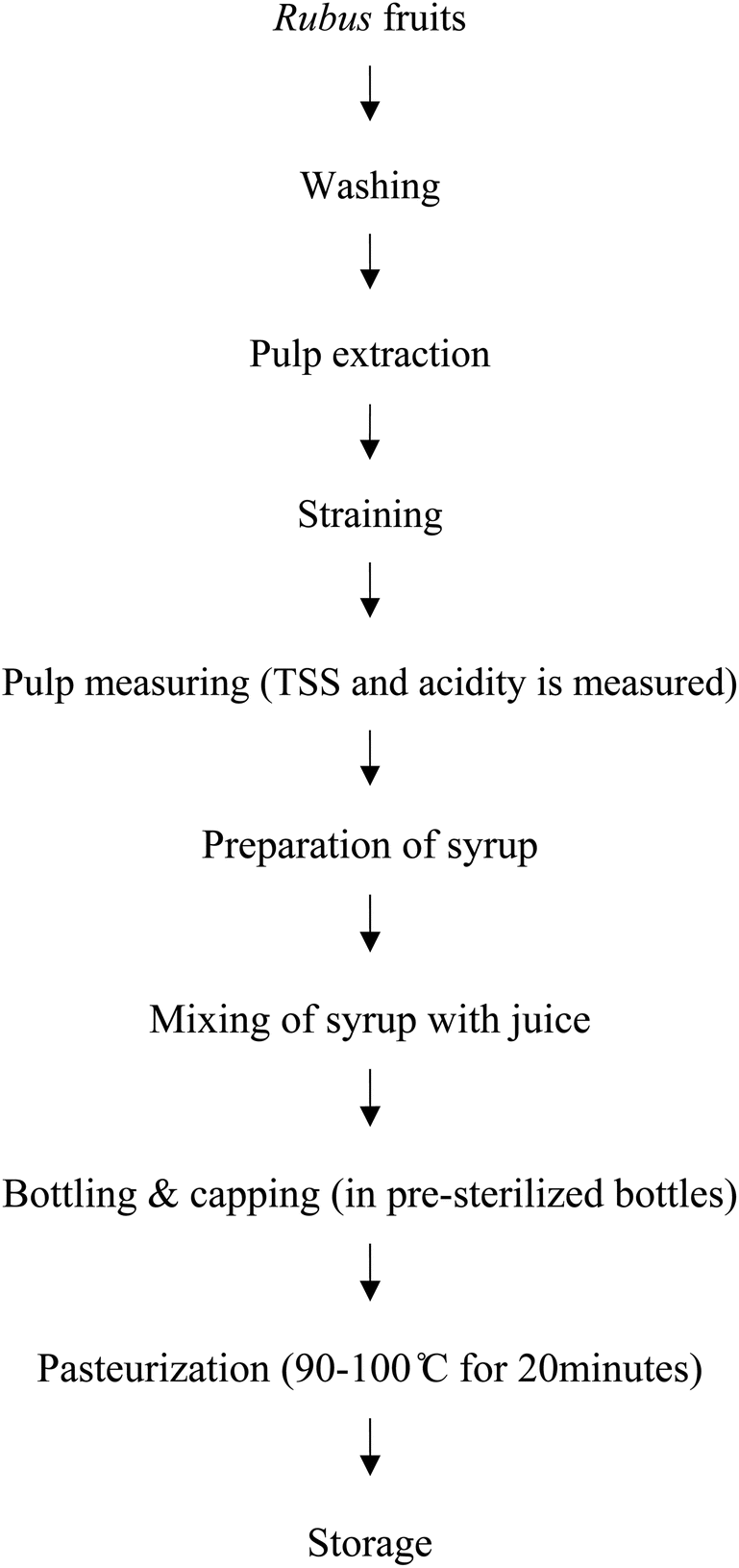
Ripe berries were selected and thoroughly washed with clean water. The berries were then subjected to pulping and the pulp was then mixed with the sugar syrup that was prepared according to the TSS required. Six treatment combinations were developed: T1, T2, and T3: contained 25% pulp with total soluble solids (TSS) 40 °Bx, 45 °Bx and 50 °Bx respectively, while T4, T5, and T6 contained 30% pulp with TSS of 40 °Bx, 45 °B and 50 °Bx respectively. The prepared squash was packaged in glass bottles and was then pasteurized (Chart 1). The samples were stored under ambient conditions for 6 months and analyzed at monthly intervals for physicochemical, nutritional, color, bioactive compounds, antioxidant activity and sensory attributes.
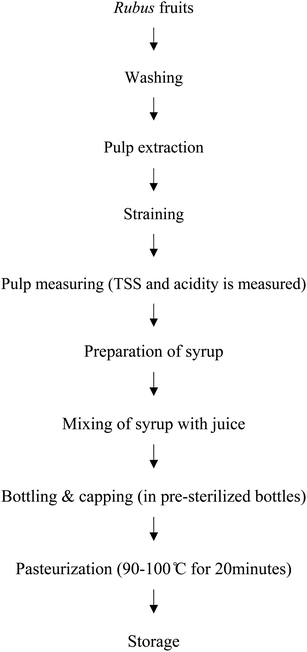 |
| | Chart 1 Preparation of Rubus squash. | |
2.3. Quality evaluation of squash
2.3.1. Total soluble solids (TSS).
The TSS were determined by using a hand-held refractometer (ATAGO) and results were expressed as degree Brix (°Bx).
2.3.2. Titratable acidity (TA).
TA was analyzed according to Ranganna6 by titrating 10 mL of squash with 0.1 N NaOH, using phenolphthalein as an indicator and expressed as percentage citric acid. Acidity was calculated by using eqn (1).| |  | (1) |
2.3.3. Total sugars.
Total sugars were determined using the Lane and Eynon method (Ranganna).6 Briefly, a 100 mL lead-free aliquot was treated with 20 mL of 50% HCl and held at room temperature for 24 hours. After neutralization with 0.1 N NaOH, the volume was made up to 250 mL with distilled water. The solution was then titrated against Fehling solutions A and B using methylene blue indicator until a brick red color appeared. The total sugars were determined using eqn (2);| |  | (2) |
2.3.4. Total anthocyanins.
Total anthocyanin content was determined according to Ranganna.6 10 mL of the squash sample was mixed with 50 mL ethanolic HCL (85![[thin space (1/6-em)]](https://www.rsc.org/images/entities/char_2009.gif) :15) and diluted to 100 mL in a volumetric flask. The mixture was refrigerated overnight at 4 °C, filtered through Whatman No. 1 filter paper, and absorbance was measured at 535 nm using a UV-vis double beam spectrophotometer (iGENE LABSERVE: IG-28DS). The results were expressed as mg anthocyanin per 100 mL of squash. Anthocyanin content was calculated using eqn (3) and (4).
:15) and diluted to 100 mL in a volumetric flask. The mixture was refrigerated overnight at 4 °C, filtered through Whatman No. 1 filter paper, and absorbance was measured at 535 nm using a UV-vis double beam spectrophotometer (iGENE LABSERVE: IG-28DS). The results were expressed as mg anthocyanin per 100 mL of squash. Anthocyanin content was calculated using eqn (3) and (4).| |  | (3) |
| |  | (4) |
2.3.5. Vitamin C.
Ascorbic acid content was determined according to Ranganna.6 The samples were homogenized with 3% metaphosphoric acid, and filtered and titrated against 2,6-dichlorophenol-indophenol dye solution (containing 1 g dye and 42 mg sodium carbonate in 150 mL water) until a pink endpoint persisted for 15 s. The dye factor was calculated by using eqn (5):| | 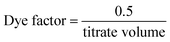 | (5) |
The results were expressed as mg ascorbic acid per 100 mL of sample and was calculated as:
2.3.6. Total phenolic content and total flavonoid content.
2.3.6.1. Sample preparation.
For all treatments, phenols and flavonoids were extracted using methanol. Squash samples (2 mL) were mixed with methanol (8 mL), and centrifuged at 1680×g for 10 minutes. The supernatant was collected for total phenol and flavonoid analysis.7
2.3.6.2. Total phenolic content (TPC).
The TPC of Rubus squash was evaluated using the Folin-Ciocalteu method8 and was quantified as milligrams of gallic acid equivalents per 100 mL (mg GAE/100 mL).
2.3.6.3. Total flavonoid content (TFC).
The TFC of the squash extracts was assessed using the Aluminium chloride complex forming assay,9 and expressed as milligrams of quercetin equivalents per 100 mL (mg QE/100 mL).
2.3.7. Antioxidant activity (%DPPH inhibition).
Antioxidant activity was determined using the DPPH method (Brand-Williams).10 Samples (5 mL) were extracted with methanol (10 mL) for 2 hours. The methanolic extract (0.1 mL) was mixed with DPPH solution (3.9 mL) and incubated for 30 minutes, after which absorbance was measured at 517 nm. The results were expressed as percentage DPPH radical inhibition using the following eqn (6);| |  | (6) |
2.3.8. Instrumental color.
The color profile of squash samples was assessed using a Hunter Lab Colorimeter (Model CM-508d Minolta co., Japan). The device measured CIELAB coordinates: L* (brightness), a* (red-green), and b* (yellow-blue). Before taking measurements, the instrument underwent calibration using standard black and white tiles.
2.3.9. Turbidity.
Turbidity or cloudiness of all squash treatments was determined using a turbidity meter (Aquasol AP-TB-01). Measurements were conducted at room temperature (25 ± 2 °C) by placing 10 mL of each sample into clean glass cuvettes. The results were expressed in Nephelometric Turbidity Units (NTU), and each measurement was performed in triplicate to ensure accuracy.
2.3.10. Determination of phenolic compounds by HPLC.
2.3.10.1. Extraction and sample preparation.
Squash samples were prepared for HPLC analysis following Magiera and Zaręba11 with modifications. The samples (5 mL) were mixed with 80% methanol (20 mL), sonicated for 20 minutes, and centrifuged at 1680×g for 15 minutes. The extraction was repeated twice, and combined filtrates were concentrated using a rotary evaporator at 40 °C. The concentrated samples were stored at −20 °C and reconstituted in 3 mL of mobile phase A and B (1:1) before analysis.
2.3.10.2. HPLC-DAD analysis.
HPLC analysis was performed using an Agilent Technologies 1260 Infinity series system equipped with a quaternary pump, manual injector (20 μL loop), and Diode Array Detector (DAD). Separation was achieved on a Zorbax-SB C18 column (5 μm × 4.6 × 150 mm) using EZ-Chrome software for data acquisition and analysis. The mobile phase consisted of 0.1% trifluoroacetic acid in water (A) and acetonitrile (B) with a gradient elution system of 2% A and 98% B at 1 mL min−1 flow rate. The injection volume was 20 μL, with column temperature maintained at 30 °C and sampler at 4 °C. Mobile phases were filtered and degassed by sonication for 20 minutes before use. Analytes were detected using DAD at wavelengths of 230, 280, 320, and 520 nm.
2.3.11. Sensory characteristics.
Sensory evaluation of Rubus blackberry squash was conducted by a 20 semi-trained membered panel from the Division of Food Science and Technology, SKUAST-K. Samples were evaluated under daylight conditions using a nine-point hedonic scale (9 = like extremely to 1 = dislike extremely) for color, flavor, taste, appearance and mouthfeel. All the panelists rinsed their mouth with water before tasting each sample. Panelists rinsed their mouth with water between samples. Ethical permission: it was not required and the prior informed consent was obtained from all the individual panelists for the study.
2.4. Statistical analysis
The means and standard deviations of all triplicate (n = 3) measurements were calculated for each analysis in the current study. Two-way analysis of variance (ANOVA) was conducted to determine significant differences among the mean values. Subsequently, Duncan's LSD test was employed to identify specific differences, utilizing the commercial statistical package SPSS ver.11.5 (SPSS Inc., Chicago, IL, USA), with a significance level set at 5% (p ≤ 0.05). Additionally, Pearson's correlation coefficient (r) was calculated in SPSS to assess correlation between vitamin C, total phenols, total flavonoids, total anthocyanins and antioxidant activity.
3. Results and discussion
3.1. Quality evaluation of Rubus squash during storage
3.1.1. Total soluble solids (TSS).
During storage, the TSS value of all squash treatments increased significantly (p ≤ 0.05), irrespective of the pulp content (Table 1). The TSS were found to be the highest in T6 (30% pulp and 50 °Bx) followed by T5 (30% pulp and 45 °Bx). TSS values for the squash samples on the 180th day of storage were observed to be 42.01 °Bx, 47.11 °Bx, 52.51 °Bx, 43.03 °Bx, 48.02 °Bx, and 53.09 °Bx for T1, T2, T3, T4, T5 and T6, respectively. The gradual increase in the TSS value of squash samples during the storage period might be due to continuous enhancement in hydrolysis of acids and polysaccharides. Kumar12 observed a similar trend of change in TSS value of squash prepared from different cultivars of mango during a storage period of 180 days. Ullah13 and Sasikumar14 also reported an increase in TSS value from 15.3 °Bx to 17 °Bx in the blended beverages of carrot, Kinnow, lemon and ginger and 14.01 °Bx to 14.83 °Bx in blood fruit beverage, respectively.
Table 1 Effect of treatments on TSS, acidity, total sugars and anthocyanin content of squash samples during a storage period of six monthsa,b,c
| Treatment |
S1 |
S2 |
S3 |
S4 |
S5 |
S6 |
S7 |
|
Values are expressed as mean ± standard deviation.
Values with different superscripts (small letters) (within rows) differ significantly (p ≤ 0.05).
Values with different superscripts (capital letters) (within columns) differ significantly (p ≤ 0.05).
|
|
TSS°Bx
|
| T1 |
40.00 ± 0aA |
40.16 ± 0.03bA |
40.41 ± 0.04cA |
40.69 ± 0.03dA |
41.04 ± 0.04eA |
41.48 ± 0.03fA |
42.01 ± 0.02gA |
| T2 |
45.00 ± 0aB |
45.21 ± 0.05bB |
45.49 ± 0.03cB |
45.82 ± 0.05dB |
46.21 ± 0.03eB |
46.62 ± 0.06fB |
47.11 ± 0.05gB |
| T3 |
50.00 ± 0aC |
50.25 ± 0.03bC |
50.56 ± 0.04cC |
50.94 ± 0.06dC |
51.37 ± 0.06eC |
51.86 ± 0.04fC |
52.51 ± 0.05gC |
| T4 |
40.00 ± 0aA |
40.25 ± 0.05bA |
40.62 ± 0.05cD |
41.09 ± 0.05dD |
41.67 ± 0.07eD |
42.31 ± 0.04fD |
43.03 ± 0.05gD |
| T5 |
45.00 ± 0aB |
45.25 ± 0.02bB |
45.59 ± 0.04cB |
46.06 ± 0.03dE |
46.64 ± 0.05eE |
47.28 ± 0.03fE |
48.02 ± 0.06gE |
| T6 |
50.00 ± 0aC |
50.25 ± 0.03bC |
50.61 ± 0.04cC |
51.09 ± 0.05dF |
51.68 ± 0.03eF |
52.33 ± 0.05fF |
53.09 ± 0.06gF |
|
|
Titratable acidity (%)
|
| T1 |
1.00 ± 0Aa |
1.00 ± 0.04Aa |
1.01 ± 0.06Aa |
1.02 ± 0.03Aa |
1.04 ± 0.04Aa |
1.07 ± 0.03Aa |
1.11 ± 0.07Aa |
| T2 |
1.00 ± 0Aa |
1.00 ± 0.08Aa |
1.02 ± 0.07Aa |
1.05 ± 0.08Aab |
1.09 ± 0.06ABab |
1.14 ± 0.04ABab |
1.20 ± 0.03ABb |
| T3 |
1.00 ± 0Aa |
1.00 ± 0.05Aa |
1.03 ± 0.04Aab |
1.07 ± 0.06Aab |
1.12 ± 0.05ABabc |
1.18 ± 0.03ABbc |
1.25 ± 0.11ABCc |
| T4 |
1.00 ± 0Aa |
1.00 ± 0.04Aa |
1.04 ± 0.05Aa |
1.09 ± 0.07Aab |
1.15 ± 0.06ABabc |
1.22 ± 0.08ABbc |
1.30 ± 0.05BCc |
| T5 |
1.00 ± 0Aa |
1.00 ± 0.08Aa |
1.05 ± 0.04Aa |
1.11 ± 0.06Aab |
1.18 ± 0.05ABabc |
1.26 ± 0.08Bbc |
1.35 ± 0.07BCc |
| T6 |
1.00 ± 0Aa |
1.00 ± 0.05Aa |
1.06 ± 0.08Aab |
1.13 ± 0.05Aab |
1.21 ± 0.06Bbc |
1.30 ± 0.07Bcd |
1.40 ± 0.04Cd |
|
|
Total sugars (%)
|
| T1 |
31.05 ± 0.06aA |
31.28 ± 0.05bA |
31.53 ± 0.04cA |
31.83 ± 0.08dA |
32.18 ± 0.07eA |
32.55 ± 0.05fA |
32.97 ± 0.07gA |
| T2 |
35.23 ± 0.04aB |
35.48 ± 0.05bB |
35.75 ± 0.03cB |
36.06 ± 0.06dB |
36.42 ± 0.07eB |
36.81 ± 0.08fB |
37.26 ± 0.06gB |
| T3 |
39.45 ± 0.03aC |
39.72 ± 0.05bC |
40.05 ± 0.05cC |
40.41 ± 0.04dC |
40.79 ± 0.03eC |
41.21 ± 0.07fC |
41.67 ± 0.07gC |
| T4 |
33.25 ± 0.06aD |
33.51 ± 0.07bD |
33.86 ± 0.04cD |
34.27 ± 0.03dD |
34.75 ± 0.07eD |
35.31 ± 0.05fD |
35.98 ± 0.05gD |
| T5 |
37.32 ± 0.06aE |
38.12 ± 0.04bE |
38.48 ± 0.05cE |
38.82 ± 0.06dE |
39.24 ± 0.04eE |
39.69 ± 0.04fE |
40.17 ± 0.05gE |
| T6 |
42.12 ± 0.07aF |
42.45 ± 0.05bF |
42.81 ± 0.03cF |
43.21 ± 0.05dF |
43.63 ± 0.04eF |
44.10 ± 0.06fF |
44.61 ± 0.04gF |
|
|
Total anthocyanin content (mg/100 mL)
|
| T1 |
80.72 ± 0.05aA |
79.62 ± 0.03bA |
78.32 ± 0.06cA |
76.97 ± 0.04dA |
75.59 ± 0.05eA |
74.19 ± 0.07fA |
72.74 ± 0.03gA |
| T2 |
79.05 ± 0.03Ab |
77.65 ± 0.04bB |
76.02 ± 0.07cB |
74.64 ± 0.07dB |
73.24 ± 0.05eB |
71.84 ± 0.03fB |
70.51 ± 0.07gB |
| T3 |
78.45 ± 0.04aC |
77.11 ± 0.07bC |
75.77 ± 0.05cC |
74.36 ± 0.03dC |
72.88 ± 0.05eC |
71.35 ± 0.04fC |
69.75 ± 0.06gC |
| T4 |
83.57 ± 0.04aD |
82.35 ± 0.03bD |
81.07 ± 0.05cD |
79.72 ± 0.06Dd |
78.33 ± 0.08eD |
76.86 ± 0.03fD |
75.31 ± 0.05gD |
| T5 |
82.76 ± 0.05aE |
81.51 ± 0.03bE |
80.21 ± 0.06cE |
78.83 ± 0.04dE |
77.38 ± 0.07eE |
75.89 ± 0.05fE |
74.33 ± 0.06gE |
| T6 |
81.45 ± 0.07aF |
80.22 ± 0.05bF |
78.95 ± 0.03cF |
77.62 ± 0.06dF |
76.24 ± 0.05eF |
74.83 ± 0.04fF |
73.35 ± 0.03gF |
3.1.2. Titratable acidity (TA).
The initial acid content was maintained at 1% across all squash treatments. During the six month storage period, the TA of squash samples increased significantly (p ≤ 0.05) (Table 1). Treatment T6 exhibited the highest TA, followed by T5, while T3 showed the lowest acid content. The increase in TA during storage can be attributed to several factors. The conversion of sugars and other carbohydrates leads to the formation of various organic acids such as citric acid during storage. Additionally, the oxidative breakdown of vitamin C (ascorbic acid) into dehydroascorbic acid and hydrolysis of pectin compounds releases free galacturonic acid, which increases the overall acidity of the product. These findings align with several recent studies. Purewal15 reported similar increasing trends in acidity for kinnow-amla beverages during storage. Comparable results were observed in jambul squash by Nadeem.16
3.1.3. Total sugars.
The total sugar content of all squash treatments increased significantly (p ≤ 0.05) during 180 days of storage irrespective of pulp content (Table 1). The maximum (44.61%) and minimum (32.97%) total sugar content was recorded in squash prepared from 30% and 25% pulp (T6 and T1, respectively). The increase in total sugar content during storage can be attributed to the hydrolysis of polysaccharides such as pectin and starch into simple sugars. Our results align with the findings of Mahnoori17 who reported similar increasing trends in sugar content for litchi-beetroot blended RTS beverage. Comparable trends of increasing sugars were observed by Sharma18 in Jamun-mango RTS beverage.
3.1.4. Total anthocyanin content.
For the squash samples the anthocyanin content is presented in Table 1, where a significant (p ≤ 0.05) decrease was observed during the storage period. Among the treatments T4 exhibited the maximum anthocyanin content (75.31 mg/100 mL), while the lowest content (69.75 mg/100 mL) was recorded for T3. The degradation of anthocyanins during storage can be attributed to auto-oxidation and structural transformation of anthocyanin molecules, which is accelerated by various environmental and chemical factors such as temperature-dependent degradation kinetics, where higher storage temperatures accelerate breakdown, presence of oxygen leading to oxidative degradation, light exposure catalyzing photochemical degradation, and enzymatic activities contributing to anthocyanin breakdown. Additionally, the formation of polymeric compounds through condensation reactions between anthocyanins and other phenolic compounds can lead to color changes and reduced measurable anthocyanin content. Similar patterns of anthocyanin degradation have been reported in various fruit products. Muche19 observed degradation of both individual and total anthocyanins during the storage period of juice prepared from Merlot and Ruby grapes. Similarly, Mahnoori17 reported declines in anthocyanin content during the storage of litchi-beetroot RTS.
3.1.5. Vitamin C.
For the fresh samples of squash, vitamin C content was the highest in T4 (23.75 mg/100 mL) and lowest in T3 (18.96 mg/100 mL) as depicted in Table 2. This variation can be attributed to differences in pulp concentration, TSS value, and processing time variations. Processing time particularly plays a crucial role, as shorter durations generally result in better vitamin C retention, while extended processing can lead to thermal degradation of this heat-sensitive nutrient. During storage, a significant (p ≤ 0.05) decrease in vitamin C content was observed across all treatments with T4 maintaining the highest retention, followed by T5, while T3 showed the lowest retention. This decline can be primarily attributed to oxidative degradation, while L-ascorbic acid converts to dehydroascorbic acid and subsequently degrades to 2,3-diketogulonic acid, representing an irreversible loss of vitamin C. The degradation process is catalyzed by various environmental factors including oxygen exposure, light and heat fluctuations during storage. The residual oxygen in the bottle headspace particularly accelerates this oxidation process, while enzymatic degradation through residual ascorbic acid oxidase activity and the presence of metal ions further contributes to vitamin C loss. Similar patterns of vitamin C degradation have been documented by several researchers in various fruit beverages. Kumar12 reported significant vitamin C losses in mango squash during storage at ambient temperature, while Purewal15 observed a gradual decrease in vitamin C content of Kinnow-Amla blended beverage.
Table 2 Effect of treatments on vitamin C, total phenolic content, total flavonoid content and antioxidant activity of squash samples during a storage period of six monthsa,b,c
| Treatment |
S1 |
S2 |
S3 |
S4 |
S5 |
S6 |
S7 |
|
Values are expressed as mean ± standard deviation.
Values with different superscripts (small letters) (within rows) differ significantly (p ≤ 0.05).
Values with different superscripts (capital letters) (within columns) differ significantly (p ≤ 0.05).
|
|
Vitamin C (mg/100 mL)
|
| T1 |
20.76 ± 0.03aA |
20.32 ± 0.0Ab |
19.78 ± 0.07Ac |
19.16 ± 0.05Ad |
18.41 ± 0.07Ae |
17.58 ± 0.05Af |
16.68 ± 0.04Ag |
| T2 |
19.85 ± 0.06aB |
19.37 ± 0.06Bb |
18.85 ± 0.04Bc |
18.22 ± 0.07Bd |
17.51 ± 0.08Be |
16.68 ± 0.06Bf |
15.77 ± 0.04Bg |
| T3 |
18.96 ± 0.04aC |
18.45 ± 0.03Cb |
17.91 ± 0.03Cc |
17.27 ± 0.07Cd |
16.52 ± 0.05Ce |
15.67 ± 0.04Cf |
14.75 ± 0.09Cg |
| T4 |
23.75 ± 0.06aD |
23.43 ± 0.04Db |
22.98 ± 0.05Dc |
22.43 ± 0.09Dd |
21.82 ± 0.06De |
21.09 ± 0.07Df |
20.28 ± 0.05Dg |
| T5 |
22.88 ± 0.04aE |
22.47 ± 0.09Eb |
21.93 ± 0.03Ec |
21.29 ± 0.05Ed |
20.58 ± 0.04Ee |
19.76 ± 0.05Ef |
18.82 ± 0.07Eg |
| T6 |
21.84 ± 0.03aF |
21.42 ± 0.06Fb |
20.91 ± 0.05Fc |
20.27 ± 0.04Fd |
19.55 ± 0.03Fe |
18.74 ± 0.07Ff |
17.83 ± 0.07Fg |
|
|
Total phenolic content (mg GAE/100 mL)
|
| T1 |
433.38 ± 0.03aA |
429.13 ± 0.07bA |
418.51 ± 0.06cA |
404.39 ± 0.05dA |
386.39 ± 0.07eA |
363.27 ± 0.09fA |
335.65 ± 0.12gA |
| T2 |
414.57 ± 0.08aB |
408.62 ± 0.05bB |
400.87 ± 0.13Cb |
386.46 ± 0.07dB |
369.82 ± 0.09eB |
318.72 ± 0.08fB |
318.72 ± 0.11gB |
| T3 |
390.68 ± 0.04aC |
384.83 ± 0.07bC |
376.32 ± 0.09cC |
364.10 ± 0.06dC |
346.88 ± 0.11eC |
324.03 ± 0.05fC |
294.53 ± 0.07gC |
| T4 |
524.03 ± 0.09aD |
521.48 ± 0.06bD |
514.94 ± 0.12cD |
503.49 ± 0.08dD |
487.94 ± 0.05eD |
470.26 ± 0.07fD |
447.95 ± 0.09gD |
| T5 |
504.43 ± 0.08a |
500.78 ± 0.12bE |
495.56 ± 0.06cE |
485.11 ± 0.13dE |
468.69 ± 0.09eE |
449.34 ± 0.05fE |
426.39 ± 0.06gE |
| T6 |
480.28 ± 0.07aF |
476.63 ± 0.09bF |
470.41 ± 0.11cF |
459.36 ± 0.06dF |
442.56 ± 0.08eF |
402.28 ± 0.12fF |
399.83 ± 0.13gF |
|
|
Total flavonoid content (mg QE/100 mL)
|
| T1 |
191.32 ± 0.06aA |
189.67 ± 0.05bA |
186.78 ± 0.08cA |
181.13 ± 0.11dA |
172.25 ± 0.07eA |
160.43 ± 0.09fA |
143.49 ± 0.11gA |
| T2 |
183.17 ± 0.09aB |
181.39 ± 0.07bB |
178.45 ± 0.05cB |
178.45 ± 0.11dB |
172.58 ± 0.08eB |
163.33 ± 0.06fB |
132.88 ± 0.13gB |
| T3 |
176.51 ± 0.07aC |
174.67 ± 0.09bC |
170.93 ± 0.11cC |
164.35 ± 0.08dC |
154.69 ± 0.12eC |
140.94 ± 0.13fC |
124.22 ± 0.09gC |
| T4 |
223.69 ± 0.11aD |
222.01 ± 0.09aD |
219.68 ± 0.05bD |
216.23 ± 0.12bD |
209.55 ± 0.06cD |
202.21 ± 0.08dD |
193.89 ± 0.12eD |
| T5 |
206.95 ± 0.08aE |
205.23 ± 0.11bE |
202.78 ± 0.09cE |
199.12 ± 0.07dE |
192.34 ± 0.12eE |
184.68 ± 0.06fE |
173.35 ± 0.07gE |
| T6 |
201.15 ± 0.12aF |
199.29 ± 0.06bF |
196.68 ± 0.09cF |
192.68 ± 0.13dF |
185.46 ± 0.06eF |
176.01 ± 0.08fF |
163.39 ± 0.11gF |
|
|
%DPPH inhibition activity
|
| T1 |
82.98 ± 0.05aA |
81.88 ± 0.04bA |
80.58 ± 0.03cA |
79.28 ± 0.06dA |
77.98 ± 0.07eA |
76.68 ± 0.07fA |
75.38 ± 0.05gA |
| T2 |
81.81 ± 0.04aB |
80.51 ± 0.06bB |
79.21 ± 0.05cB |
77.91 ± 0.07dB |
76.61 ± 0.03eB |
75.31 ± 0.04fB |
74.01 ± 0.05gB |
| T3 |
81.72 ± 0.04aB |
80.42 ± 0.03bB |
79.12 ± 0.05cB |
77.82 ± 0.06dB |
76.52 ± 0.05eB |
75.22 ± 003fB |
73.92 ± 0.07gB |
| T4 |
85.78 ± 0.05aC |
84.48 ± 0.04bC |
83.18 ± 0.06cC |
81.88 ± 0.07dC |
80.58 ± 0.08eC |
79.28 ± 0.06fC |
77.98 ± 0.05gC |
| T5 |
84.87 ± 0.04aD |
83.57 ± 0.11bD |
82.27 ± 0.06cD |
80.97 ± 0.04dD |
79.67 ± 0.04eD |
78.37 ± 0.05fD |
77.07 ± 0.06gD |
| T6 |
84.62 ± 0.05aE |
83.32 ± 0.06bE |
82.02 ± 0.05cE |
80.72 ± 0.07dE |
79.42 ± 0.06eE |
78.12 ± 0.06fE |
76.82 ± 0.04gE |
3.1.6. Total phenol (TPC) and flavonoid content (TFC).
Table 2 illustrates the TPC and TFC of the squash samples demonstrating a significant decrease (p ≤ 0.05) during the 6-month storage period. Treatment T4 exhibited the highest TPC (447.95 mg GAE/100 mL) and TFC (193.89 mg QE/100 mL), while T3 showed the lowest values for both TPC (294.95 mg GAE/100 mL) and TFC (124.22 mg QE/100 mL). The observed decline in TPC and TFC during storage can be attributed to multiple factors, primarily their sensitivity to environmental factors, particularly temperature. Higher storage temperatures accelerate degradation through increased enzymatic activity and oxidative reactions, while exposure to light particularly UV radiation, triggers photochemical degradation of phenolic compounds. The degradation process is further complicated by various biochemical mechanisms. Enzymes such as polyphenol oxidase (PPO) and peroxidase (POD) catalyze the oxidation of phenolic compounds, while protein–phenol interactions lead to the formation of insoluble complexes through hydrogen bonding and hydrophobic interactions. Additionally, polymerization reactions result in the formation of larger molecular weight compounds with reduced bioavailability, contributing to the overall decrease in measurable phenolic content. These findings align with several recent studies, including that of Mohamad,21 who recorded similar degradation patterns in watermelon juice stored at varying temperatures, and Purewal15 who demonstrated temperature dependent phenolic degradation in functional beverages. Similar observations were also made by Thakur and Thakur22 in box myrtle syrup, Sasikumar23 in sohiong based freeze dried premix, as well as by Krishna24 in bayberry and yellow Himalayan raspberry-based beverages. Moreover, the TPC of blood fruit beverage aligns with our findings.20
3.1.7. Antioxidant activity.
Table 2 illustrates the effect of storage on DPPH radical scavenging activity across different squash treatments. Initially, T4 exhibited the highest antioxidant activity (85.78%), followed by T5 (84.87%), while T3 showed the lowest activity (81.72%). Over 180 days of storage, a significant decrease (p ≤ 0.05) in DPPH inhibition activity was observed across all treatments, with T4 maintaining the highest activity (77.98%) and T3 showing the lowest (73.92%). However, the decline in antioxidant activity can be attributed to several factors such as oxidative degradation of bioactive compounds during storage, particularly in the presence of oxygen, light and elevated temperatures, progressive degradation of ascorbic acid leading to the formation of dehydroascorbic acid and further breakdown products and a possible Maillard reaction between reducing sugars and amino acids, affecting the overall antioxidant profile. Similar declining trends in antioxidant activity during storage have been reported in various fruit beverages such as jambul squash16 and in watermelon juice.21 Moreover, the %DPPH inhibition of Sohiong fruit aligns with our findings.20
3.1.8. Color.
During storage of squash samples, the L* a*, and b* values varied significantly (p ≤ 0.05) as shown in Table 3. Initially, L* values ranged from 25.98–24.37; a* values ranged from 20.99–21.71 and b* values ranged from 0.87–0.72. Over the six months of storage, the highest L* value (35.63) was recorded for T3 and the lowest (26.54) for T4. For a* values, T4 showed the highest (20.45), and T3 the lowest (16.85), while the highest b* value was recorded for T3 (1.02) and lowest for T4 (0.54). These chromatic changes can be attributed to several factors. The primary reason is the degradation of phenolic compounds and anthocyanins during storage, which directly influences color parameters. The observed color variations also reflect Maillard browning reactions, enzymatic browning and the formation of polymeric color compounds during storage. A positive correlation was observed between the L* and a* values with total phenolic content, indicating that treatments with higher phenolic content exhibited a darker appearance, more intense reddish hues, and reduced yellowness. These findings align with previous studies that demonstrated similar correlations between chromatic parameters and phenolic compounds in processed juices from blackberry and elderberry.25
Table 3 Effect of treatments on color (L* a* b*) and turbidity of squash samples during a storage period of six monthsa,b,c
| Treatment |
S1 |
S2 |
S3 |
S4 |
S5 |
S6 |
S7 |
|
Values are expressed as mean ± standard deviation.
Values with different superscripts (small letters) (within rows) differ significantly (p ≤ 0.05).
Values with different superscripts (capital letters) (within columns) differ significantly (p ≤ 0.05).
|
|
L* value
|
| T1 |
25.98 ± 0.14aA |
26.59 ± 0.13bA |
27.19 ± 0.12cA |
28.78 ± 0.15dA |
29.35 ± 0.12eA |
30.91 ± 0.14fA |
31.46 ± 0.15gA |
| T2 |
27.84 ± 0.13aB |
28.46 ± 0.13bB |
29.07 ± 0.15cB |
30.67 ± 0.14dB |
31.26 ± 0.13eB |
32.84 ± 0.13fB |
33.41 ± 0.15gB |
| T3 |
29.94 ± 0.12aC |
30.38 ± 0.13bC |
31.21 ± 0.12cC |
32.83 ± 0.15dC |
33.44 ± 0.13eC |
34.04 ± 0.11fC |
35.63 ± 0.11gC |
| T4 |
20.41 ± 0.13aD |
21.79 ± 0.14bD |
22.16 ± 0.17cD |
23.52 ± 0.15dD |
24.87 ± 0.14eD |
25.21 ± 0.12fD |
26.54 ± 0.15gD |
| T5 |
22.63 ± 0.15aE |
23.04 ± 0.11bE |
24.44 ± 0.12cE |
25.83 ± 0.14dE |
26.21 ± 0.13eE |
27.58 ± 0.15fE |
28.65 ± 0.16gE |
| T6 |
24.37 ± 0.14aF |
25.86 ± 0.11bF |
26.34 ± 0.15cF |
27.81 ± 0.13dF |
28.37 ± 0.12eF |
29.72 ± 0.14fF |
30.15 ± 0.13gF |
|
|
a* value
|
| T1 |
20.99 ± 0.17aA |
20.51 ± 0.14bA |
20.03 ± 0.16cA |
19.57 ± 0.12dA |
19.12 ± 0.16eA |
18.68 ± 0.13fA |
18.25 ± 0.14gA |
| T2 |
19.44 ± 0.13aB |
19.06 ± 0.17abB |
18.69 ± 0.25bcB |
18.33 ± 0.14cdB |
17.98 ± 0.11deB |
17.64 ± 0.13efB |
17.31 ± 0.12fB |
| T3 |
18.97 ± 0.15aC |
18.59 ± 0.12abC |
18.22 ± 0.14bcB |
17.86 ± 0.13cdC |
17.51 ± 0.14deC |
17.17 ± 0.15efC |
16.85 ± 0.17fC |
| T4 |
22.48 ± 0.13aD |
22.16 ± 0.11abD |
21.84 ± 0.17bcC |
21.51 ± 0.15cdD |
21.17 ± 0.16deD |
20.83 ± 0.13efD |
20.45 ± 0.14fD |
| T5 |
22.08 ± 0.11aE |
21.76 ± 0.13abE |
21.43 ± 0.12bcCD |
21.09 ± 0.14cdE |
20.75 ± 0.11deE |
20.40 ± 0.15eE |
20.02 ± 0.16fE |
| T6 |
21.71 ± 0.14aE |
21.39 ± 0.17abE |
21.06 ± 0.16bcD |
20.71 ± 0.12cdF |
20.34 ± 0.15deF |
19.97 ± 0.14eF |
19.57 ± 0.11fF |
|
|
b* value
|
| T1 |
0.46 ± 0.07ABa |
0.54 ± 0.08ABab |
0.62 ± 0.05Aab |
0.69 ± 0.08ABab |
0.76 ± 0.11ABab |
0.82 ± 0.09ABab |
0.87 ± 0.06ABb |
| T2 |
0.54 ± 0.12ABa |
0.63 ± 0.12ABab |
0.71 ± 0.06Aab |
0.79 ± 0.07Aab |
0.86 ± 0.09Aab |
0.93 ± 0.08Aab |
0.99 ± 0.12Ab |
| T3 |
0.68 ± 0.0.11Ba |
0.75 ± 0.09Ba |
0.82 ± 0.04Aa |
0.88 ± 0.07ADa |
0.93 ± 0.06Aa |
0.98 ± 0.03Aa |
1.02 ± 0.05Aa |
| T4 |
0.27 ± 0.06Aa |
0.31 ± 0.08Aa |
0.37 ± 0.08Aa |
0.42 ± 0.04BCDa |
0.47 ± 0.08Ba |
0.51 ± 0.05Ba |
0.54 ± 0.07Ba |
| T5 |
0.32 ± 0.09ABa |
0.39 ± 0.07ABa |
0.45 ± 0.08Aa |
0.51 ± 0.12Ca |
0.56 ± 0.08ABa |
0.61 ± 0.05ABa |
0.65 ± 0.06ABa |
| T6 |
0.39 ± 0.06ABa |
0.47 ± 0.08ABa |
0.53 ± 0.05Aa |
0.59 ± 0.07Da |
0.64 ± 0.07ABa |
0.68 ± 0.05ABa |
0.72 ± 0.11ABa |
|
|
Turbidity (NTU)
|
| T1 |
947.16 ± 0.05aA |
947.31 ± 0.08aA |
947.76 ± 0.07bA |
948.39 ± 0.11cA |
949.11 ± 0.09dA |
949.96 ± 0.04eA |
951.01 ± 0.06fA |
| T2 |
961.24 ± 0.08aB |
961.42 ± 0.11aB |
961.93 ± 0.06bB |
962.67 ± 0.08cB |
963.58 ± 0.04dB |
964.61 ± 0.07eB |
965.72 ± 0.12fB |
| T3 |
987.35 ± 0.07aC |
987.56 ± 0.06aC |
988.13 ± 0.09bC |
988.94 ± 0.11cC |
988.87 ± 0.05dC |
990.92 ± 0.12eC |
992.08 ± 0.08fC |
| T4 |
1001.17 ± 0.11aD |
1001.49 ± 0.09bD |
1002.12 ± 0.06cD |
1002.96 ± 0.08dD |
1003.89 ± 0.12eD |
1004.94 ± 0.07fD |
1006.07 ± 0.13gD |
| T5 |
1074.22 ± 0.15aE |
1074.57 ± 0.12bE |
1075.21 ± 0.11cE |
1076.07 ± 0.09dE |
1077.02 ± 0.08eE |
1078.08 ± 0.11fE |
1079.23 ± 0.13gE |
| T6 |
1095.18 ± 0.14aF |
1095.56 ± 0.09bF |
1096.22 ± 0.11cF |
1097.11 ± 0.07dF |
1098.07 ± 0.12eF |
1099.15 ± 0.13fF |
1100.32 ± 0.08gF |
3.1.9. Turbidity.
The turbidity of the squash samples provided in Table 3 varied significantly (p ≤ 0.05) during the 6-month storage period. The turbidity values (in NTU) were T1: 947.16–951.01, T2: 961.24–965.72, T3: 987.35–992.08, T4: 1001.17–1006.07, T5: 1074.22–1079.23 and T6: 1095.18–1100.32. Treatments with higher pulp concentrations (30% in T4, T5 and T6) exhibited higher turbidity compared to those with 25% pulp (T1, T2 and T3). This is likely due to the relationship between the viscosity and turbidity, as treatments with higher pulp concentration exhibited higher viscosities which in turn resulted in greater turbidity. This suggests that more viscous beverages have more stable turbidity compared to less viscous beverages. Maintaining turbidity is essential for product quality, as beverages that become clearer over time may appear less appealing. Studies by Staubmann26 support this, showing that adding stabilizers like hydrocolloids can help retain turbidity, ensuring better appearance and consistency during storage. A similar trend of increasing turbidity was reported by Mohamad21 during storage of watermelon juice.
3.1.10. Bioactive compounds.
During the six-month storage period, the concentrations of phenolic compounds in the squash samples decreased significantly (p ≤ 0.05), irrespective of pulp concentration (Table 4). Notably, treatment T4 exhibited the highest levels of key bioactive compounds, including 3,4-dihydroxybenzoic acid, gallic acid, vanillic acid, rutin, quercetin and cyanidin-3-glucoside followed by T5. Among the compounds, 3,4-dihydroxybenzoic acid (3,4-DHBA) exhibited the highest concentration in T4 (22.11 ± 0.06 mg L−1) and the lowest in T3 (16.02 ± 0.09 mg L−1) at the end of the storage period. The concentrations of 3,4-DHBA across the treatments ranged from 21.81 to 18.91 mg L−1 in T1, 20.47 to 17.51 mg L−1 in T2, 19.02 to 16.02 mg L−1 in T3, 26.64 to 22.11 mg L−1 in T4, 23.95 to 21.39 mg L−1 in T5, and 23.02 to 20.45 mg L−1 in T6. Gallic acid was the highest in T4 (78.06 ± 0.04 mg L−1) and lowest in T3 (59.94 ± 0.09 mg L−1), while quercetin showed its highest concentration in T4 (81.19 ± 0.09 mg L−1) and lowest in T3 (64.22 ± 0.12 mg L−1). Vanillic acid followed a similar trend, with T4 showing the highest concentration (0.59 ± 0.12 mg L−1) and the lowest in T3 (0.46 ± 0.07 mg L−1). The concentrations of vanillic acid across treatments ranged from 0.60 to 0.52 mg L−1 in T1, 0.57 to 0.49 mg L−1 in T2, 0.54 to 0.46 mg L−1 in T3, 0.65 to 0.59 mg L−1 in T4, 0.64 to 0.58 mg L−1 in T5 and 0.63 to 0.57 mg L−1 in T6. Rutin was also the highest in T4 (3.73 ± 0.12 mg L−1) and lowest in T3 (3.03 ± 0.07 mg L−1) with concentrations ranging from 3.81 to 3.30 mg L−1 in T1, 3.68 to 3.17 mg L−1 in T2, 3.55 to 3.03 mg L−1 in T3, 4.15 to 3.73 mg L−1 in T4, 4.06 to 3.62 mg L−1 in T5, and 3.93 to 3.48 mg L−1 in T6. Cyanidin-3-glucoside was found to be the highest in T4 (12.12 ± 0.06 mg L−1) and the lowest in T3 (10.36 ± 0.09 mg L−1). The concentrations of cyanidin-3-glucoside across treatments ranged from 12.91 to 11.30 mg L−1 in T1, and 12.52 to 10.88 mg L−1 in T2, 12.02 to 10.36 mg L−1 in T3, 13.55 to 12.12 mg L−1 in T4, 13.39 to 11.93 mg L−1 in T5 and 13.18 to 11.70 mg L−1 in T6.
Table 4 Effect of treatments on bioactive compounds (3,4-dihydroxybenzoic acid, gallic acid, vanillic acid, rutin, quercetin and cyanidin-3-glucoside) of squash samples during a storage period of six monthsa,b,c
| Treatment |
S1 |
S2 |
S3 |
S4 |
S5 |
S6 |
S7 |
|
Values are expressed as mean ± standard deviation.
Values with different superscripts (small letters) (within rows) differ significantly (p ≤ 0.05).
Values with different superscripts (capital letters) (within columns) differ significantly (p ≤ 0.05).
|
|
3–4 DHBA (mg L−
1
)
|
| T1 |
21.81 ± 0.11aA |
21.59 ± 0.09aA |
21.29 ± 0.04bA |
20.87 ± 0.13cA |
20.33 ± 0.05dA |
19.67 ± 0.06eA |
18.91 ± 0.12fA |
| T2 |
20.47 ± 0.04aB |
20.24 ± 0.07aB |
19.93 ± 0.11bB |
19.50 ± 0.08cB |
18.96 ± 0.12dB |
18.29 ± 0.13eB |
17.51 ± 0.06fB |
| T3 |
19.02 ± 0.08aC |
18.79 ± 0.05bC |
18.47 ± 0.09cC |
18.03 ± 0.07dC |
17.49 ± 0.06eC |
16.81 ± 0.11fC |
16.02 ± 0.09gC |
| T4 |
26.64 ± 0.09aD |
24.46 ± 0.11abD |
24.21 ± 0.13bD |
23.85 ± 0.05cD |
23.36 ± 0.12dD |
22.78 ± 0.07eD |
22.11 ± 0.06fD |
| T5 |
23.95 ± 0.08aE |
23.77 ± 0.11aE |
23.52 ± 0.06bE |
23.16 ± 0.12cE |
22.66 ± 0.09dE |
22.07 ± 0.04eE |
21.39 ± 0.07fE |
| T6 |
23.02 ± 0.08aF |
22.84 ± 0.07aF |
22.59 ± 0.11bF |
22.23 ± 0.09cF |
21.73 ± 0.12dF |
21.13 ± 0.06eF |
20.45 ± 0.04fF |
|
|
Gallic acid (mg L−
1
)
|
| T1 |
84.48 ± 0.08aA |
83.29 ± 0.09bA |
81.72 ± 0.12cA |
79.73 ± 0.05dA |
77.20 ± 0.07eA |
74.01 ± 0.06fA |
70.54 ± 0.08gA |
| T2 |
80.46 ± 0.05aB |
79.16 ± 0.08bB |
77.53 ± 0.06cB |
75.45 ± 0.09dB |
72.87 ± 0.11eB |
69.57 ± 0.07fA |
65.99 ± 0.09gB |
| T3 |
74.61 ± 0.06aC |
73.28 ± 0.08bC |
71.63 ± 0.07cC |
69.51 ± 0.06dC |
66.89 ± 0.05eC |
63.56 ± 0.11fC |
59.94 ± 0.09gC |
| T4 |
90.23 ± 0.08aD |
89.38 ± 0.06bD |
88.11 ± 0.05cD |
86.36 ± 0.12dD |
84.09 ± 0.08eD |
81.21 ± 0.05fD |
78.06 ± 0.08gD |
| T5 |
89.02 ± 0.05aE |
88.11 ± 0.07bE |
86.79 ± 0.08cE |
84.98 ± 0.11dE |
82.67 ± 0.06eE |
79.76 ± 0.09fE |
76.54 ± 0.12gE |
| T6 |
87.17 ± 0.05aF |
86.09 ± 0.08bF |
84.64 ± 0.12cF |
82.77 ± 0.07dF |
80.37 ± 0.06eF |
77.29 ± 0.09fE |
73.94 ± 0.11gF |
|
|
Vanillic acid (mg L−
1
)
|
| T1 |
0.60 ± 0.06aA |
0.59 ± 0.08aA |
0.58 ± 0.04aA |
0.57 ± 0.07aA |
0.56 ± 0.04aA |
0.54 ± 0.05aA |
0.52 ± 0.06aA |
| T2 |
0.57 ± 0.05aA |
0.56 ± 0.07aA |
0.55 ± 0.08aA |
0.54 ± 0.06aA |
0.53 ± 0.09aA |
0.51 ± 0.12aA |
0.49 ± 0.06aA |
| T3 |
0.54 ± 0.06aA |
0.53 ± 0.08aA |
0.52 ± 0.05aA |
0.51 ± 0.07aA |
0.50 ± 0.12aA |
0.48 ± 0.08aA |
0.46 ± 0.07aA |
| T4 |
0.65 ± 0.11aA |
0.64 ± 0.09aA |
0.63 ± 0.12aA |
0.62 ± 0.08aA |
0.61 ± 0.09aA |
0.60 ± 0.05aA |
0.59 ± 0.12aA |
| T5 |
0.64 ± 0.08aA |
0.63 ± 0.12aA |
0.62 ± 0.06aA |
0.61 ± 0.12aA |
0.60 ± 0.08aA |
0.59 ± 0.06aA |
0.58 ± 0.09aA |
| T6 |
0.63 ± 0.11aA |
0.62 ± 0.09aA |
0.61 ± 0.12aA |
0.60 ± 0.04aA |
0.59 ± 0.07aA |
0.58 ± 0.06aA |
0.57 ± 0.05aA |
|
|
Rutin (mg L−
1
)
|
| T1 |
3.81 ± 0.05aAD |
3.73 ± 0.09abAD |
3.65 ± 0.11abAD |
3.57 ± 0.08bcAD |
3.48 ± 0.13cdAD |
3.39 ± 0.08cdAD |
3.30 ± 0.11dAD |
| T2 |
3.68 ± 0.06aAB |
3.60 ± 0.09aAB |
3.52 ± 0.08abAB |
3.44 ± 0.11abAB |
3.35 ± 0.06bcAB |
3.26 ± 0.09bcAB |
3.17 ± 0.12cAB |
| T3 |
3.55 ± 0.08aB |
3.47 ± 0.07abB |
3.39 ± 0.06abB |
3.30 ± 0.05bcB |
3.21 ± 0.11cdB |
3.12 ± 0.09cdB |
3.03 ± 0.13dAB |
| T4 |
4.15 ± 0.08aCD |
4.08 ± 0.11abCD |
4.01 ± 0.07abcCD |
3.94 ± 0.12abcdCD |
3.87 ± 0.09bcdCD |
3.80 ± 0.06cdC |
3.73 ± 0.13dC |
| T5 |
4.06 ± 0.05aCD |
3.99 ± 0.07abCD |
3.92 ± 0.09abcCD |
3.85 ± 0.06abcdCD |
3.78 ± 0.08bcdCD |
3.70 ± 0.12cdCD |
3.62 ± 0.11dBCD |
| T6 |
3.93 ± 0.04aD |
3.86 ± 0.06abD |
3.79 ± 0.08abD |
3.72 ± 0.12abD |
3.64 ± 0.07bcD |
3.56 ± 0.12cD |
3.48 ± 0.09cD |
|
|
Quercetin (mg L−
1
)
|
| T1 |
82.45 ± 0.06aA |
81.80 ± 0.05bA |
80.78 ± 0.08cA |
79.40 ± 0.11dA |
77.45 ± 0.05eA |
75.14 ± 0.12fA |
72.34 ± 0.05gA |
| T2 |
78.83 ± 0.04aB |
78.15 ± 0.08bB |
77.09 ± 0.06cB |
75.68 ± 0.09dB |
73.70 ± 0.11eB |
71.34 ± 0.08fB |
68.50 ± 0.09gB |
| T3 |
74.78 ± 0.09aC |
74.07 ± 0.05bC |
72.96 ± 0.08cC |
71.51 ± 0.04dC |
69.49 ± 0.11eC |
67.09 ± 0.06fC |
64.22 ± 0.12gC |
| T4 |
90.56 ± 0.06aD |
90.01 ± 0.08bD |
89.10 ± 0.04cD |
87.85 ± 0.07dD |
86.02 ± 0.05eD |
83.87 ± 0.06fD |
81.19 ± 0.09gD |
| T5 |
88.31 ± 0.11aE |
87.73 ± 0.06bE |
86.78 ± 0.08cE |
85.47 ± 0.05dE |
83.60 ± 0.12eE |
81.39 ± 0.07fE |
78.69 ± 0.08gE |
| T6 |
85.56 ± 0.09aF |
84.95 ± 0.07bF |
83.97 ± 0.12cF |
82.35 ± 0.06dF |
80.45 ± 0.08eF |
78.18 ± 0.09fF |
75.43 ± 0.11gF |
|
|
Cyanidin-3-glucoside (mg L−
1
)
|
| T1 |
12.91 ± 0.05aA |
12.81 ± 0.07abA |
12.63 ± 0.08bcA |
12.41 ± 0.11Ca |
12.10 ± 0.09dA |
11.73 ± 0.12eA |
11.30 ± 0.06fA |
| T2 |
12.52 ± 0.11aB |
12.41 ± 0.05abB |
12.23 ± 0.09bcB |
12.00 ± 0.12cB |
11.69 ± 0.04dB |
11.31 ± 0.06eB |
10.88 ± 0.12fB |
| T3 |
12.02 ± 0.08aC |
11.91 ± 0.12abC |
11.72 ± 0.05bcC |
11.49 ± 0.13cC |
11.17 ± 0.06dC |
10.79 ± 0.11eC |
10.36 ± 0.09fC |
| T4 |
13.55 ± 0.11aD |
13.46 ± 0.05aD |
13.33 ± 0.09abD |
13.12 ± 0.12bD |
12.85 ± 0.08cD |
12.52 ± 0.13dD |
12.12 ± 0.06eD |
| T5 |
13.39 ± 0.07aDE |
13.30 ± 0.05aDE |
13.17 ± 0.11abDE |
12.95 ± 0.08bDE |
12.68 ± 0.13cD |
12.34 ± 0.07dDE |
11.93 ± 0.11eDE |
| T6 |
13.18 ± 0.05aE |
13.09 ± 0.13aE |
12.95 ± 0.09abE |
12.73 ± 0.04bE |
12.45 ± 0.06cE |
12.11 ± 0.09dE |
11.70 ± 0.12eE |
This decline can be attributed to several factors. First, the decrease in phenolic compound concentrations may be due to their condensation into brown pigments. These browning reactions can reduce the overall concentration and efficacy of the bioactive phenolic compounds. Additionally, the degradation of antioxidants, such as phenolic compounds, can lead to their oxidation under favorable conditions (e.g., exposure to light and elevated temperatures). This oxidation process can compromise the structural integrity of the bioactive compounds, resulting in a loss of their antioxidant properties. Furthermore, anthocyanins are highly unstable and susceptible to degradation, especially during processing and storage. The degradation of anthocyanins can contribute to the overall decline in phenolic compound concentrations. These conditions can alter the molecular structures of the compounds, resulting in a loss of antioxidant activity and a decline in the overall quality of the stored products. Previous studies have consistently highlighted the impact of storage temperature and conditions on the stability of bioactive compounds, emphasizing the necessity for optimal storage practices to preserve their beneficial effects over time.21Rubus squash contained higher bioactive compounds as compared to blood fruit beverage which contained gallic acid (15.60 mg L−1) and quercetin (4.10 mg L−1).20
3.1.11. Sensory evaluation.
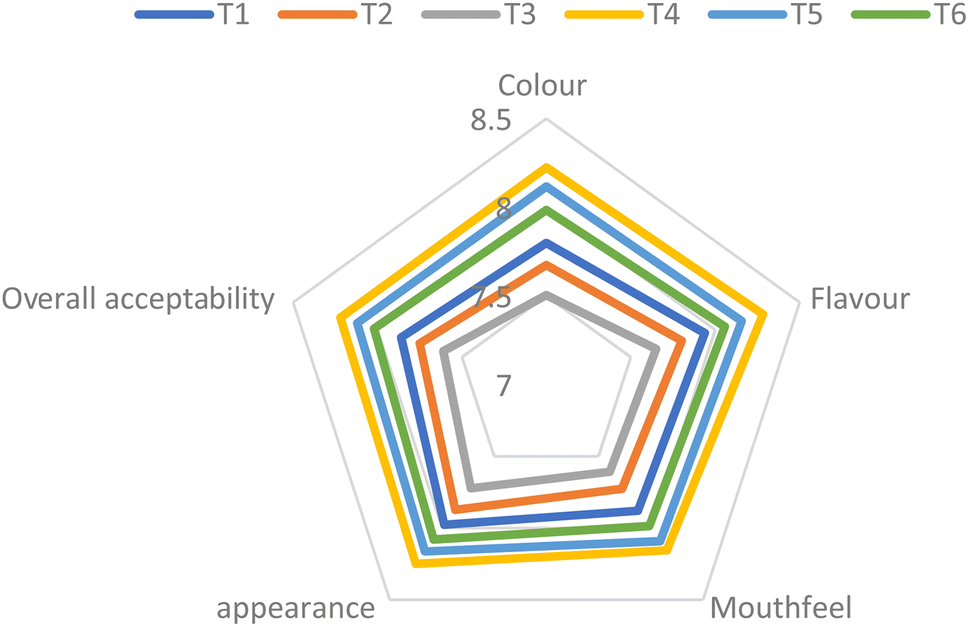
During the six-month storage period, the squash samples exhibited notable changes in color, flavor, appearance, mouthfeel, and overall acceptability. As depicted in Fig. 1, T4 had the highest score (7.80) followed by T5 (7.65), while T3 recorded the lowest (6.88). Color scores declined for all samples, ranging from 8.27 to 7.21 for T1, 8.14 to 7.11 for T2, 8.01 to 6.88 for T3, 8.56 to 7.80 for T4, 8.47 to 7.67 for T5, and 8.38 to 7.50 for T6. This decline could be attributed to the degradation of anthocyanins and browning due to the co-polymerization of organic acids in the product, as confirmed by previous studies.27–29 Flavor scores also depicted in Fig. 1, declined with storage, with T4 scoring the highest (7.73) and T3 the lowest (6.94). The flavor score ranged from 8.28 to 7.54 for T1, 8.17 to 7.39 for T2, 8.06 to 7.19 for T3, 8.57 to 7.94 for T4, 8.48 to 7.78 for T5, and 8.39 to 7.67 for T6, likely due to the degradation of phenolic compounds and aromatic substances, as reported in similar studies.30,31 Mouthfeel, evaluated in Fig. 1, showed T4 with the highest score (7.79) and T3 with the lowest (7.17), with scores ranging from 8.23 to 7.50 for T1, 8.12 to 7.30 for T2, 8.01 to 7.17 for T3, 8.48 to 7.79 for T4, 8.43 to 7.71 for T5, and 8.34 to 7.59 for T6. This decline can be linked to the gradual changes in sensory attributes and the increase in acidity over time, which affected texture and overall perception. Appearance scores, as depicted in Fig. 1, were the highest for T4 (7.93) and lowest for T3 (7.31), with scores ranging from 8.30 to 7.62 for T1, 8.21 to 7.49 for T2, 8.09 to 7.31 for T3, 8.51 to 7.93 for T4, 8.45 to 7.82 for T5, and 8.39 to 7.72 for T6. Despite the decline in appearance, all samples remained acceptable for consumption, as similarly reported by Shobha.31 The overall acceptability (OAA) scores were also the highest for T4 (8.22), followed by T5 (8.12) and lowest for T3 (7.61), consistent with the trends observed in the individual sensory attributes.
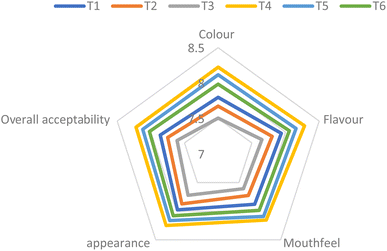 |
| | Fig. 1 Sensory evaluation of Rubus squash. | |
3.1.12. Correlation analysis.
Table 5 presents the correlation coefficients (r) between vitamin C, total phenol, total flavonoid, anthocyanins and %DPPH inhibition, to understand their better interrelation. The correlation analysis revealed a strong positive relationship between TPC and TFC (r = 0.976) suggesting that total flavonoid content is closely aligned with the total phenolic content. Table 5 also depicts a strong positive correlation between TPC, TFC, anthocyanins, vitamins and %DPPH inhibition. This indicates that as the total phenolic content increases, total flavonoids, anthocyanins, %DPPH inhibition, and vitamin C levels exhibited a proportional increase. A positive correlation between phenols, flavonoids and antioxidants has also been reported by Sasikumar.20
Table 5 Pearson's correlation between total phenols, total flavonoids, total anthocyanins, vitamin C and %DPPH inhibition
|
|
TFC |
TPC |
Anthocyanins |
Vitamin C |
%DPPH inhibition |
| TFC |
1 |
0.976 |
0.977 |
0.986 |
0.970 |
| TPC |
|
1 |
0.983 |
0.995 |
0.986 |
| Anthocyanins |
|
|
1 |
0.994 |
0.976 |
| Vitamin C |
|
|
|
1 |
0.979 |
| %DPPH |
|
|
|
|
1 |
4. Conclusion
The present study investigated the impact of varying pulp concentration and total soluble solids on the physicochemical, nutritional, and sensory properties of Rubus squash samples during a 6-month storage period. The results demonstrate that both pulp concentration and TSS value significantly (p ≤ 0.05) influenced the quality attributes of the Rubus squash. Treatments with 30% pulp and 45 °Bx TSS (T4) exhibited superior retention of bioactive compounds, antioxidant activity, and sensory properties compared to other formulations. Despite the observed declines in some parameters, all samples remained acceptable for consumption throughout the storage duration.
The study provides valuable insights into the stability and shelf-life of squash-based products, emphasizing the importance of optimizing formulation and storage conditions to maximize the preservation of nutritional and sensory qualities. The findings can guide the development of shelf-stable, high-quality squash products with enhanced consumer appeal and health benefits. Therefore, Rubus squash provides a sustainable, antioxidant-rich beverage that not only reduces the wastage of underutilized berries but also meets the increasing consumer demand for nutritious, natural products. Its health-promoting properties and long-term stability align with global efforts to create sustainable, functional food options, positioning it as a valuable addition to the market. For future research, a more detailed evaluation involving flavour and aroma profile should be done. There is scope for the development of blended squash by mixing the berries with other fruits. Also, the fortification of the Rubus squash can be done with vitamin D. Additionally, low sugar or honey can be used to develop Rubus squash as an alternative for health conscious and diabetic people.
Conflicts of interest
The authors declare that they do not have any competing financial interests or personal relationships that could have appeared to influence the work reported in this paper.
Abbreviations
| 3,4-DHBA | 3,4-Dihydroxybenzoic acid |
| °Bx | Brix |
| DPPH | 2,2-Diphenyl-1-picrylhydrazyl |
| GAE | Gallic acid equivalents |
| HPLC | High performance liquid chromatography |
| OD | Optical density |
| POD | Peroxidase |
| PPO | Polyphenol oxidase |
| QE | Quercetin equivalent |
| TFC | Total flavonoid content |
| TPC | Total phenolic content |
| TSS | Total soluble solids |
Data availability
The data used are provided in the manuscript.
References
-
S. Özokcu, Reimagining Food Security Through Sustainable Agriculture and Reduced Food Waste, 2023 Search PubMed.
- D. J. Gustafson, Indian J. Med. Res., 2013, 138, 398–410 Search PubMed.
- M. Sochor, B. Trávníček and J. C. Manning, S. Afr. J. Bot., 2018, 118, 241–259 CrossRef.
- M. Schulz and J. F. Chim, Food Biosci., 2019, 31, 100438 CrossRef CAS.
- L. Gil-Martínez, N. Mut-Salud, J. A. Ruiz-García, A. Falcón-Piñeiro, M. Maijó-Ferré, A. Baños and A. M. Gómez-Caravaca, Foods, 2023, 12, 1505, DOI:10.3390/foods12071505.
-
S. Ranganna, Handbook of Analysis and Quality Control for Fruit and Vegetable Products, Tata McGraw-Hill Education, 1986 Search PubMed.
- S. M. Wani, U. Riyaz, T. A. Wani, M. Ahmad, A. Gani, F. A. Masoodi and S. A. Mir, Cogent Food Agric., 2016, 2, 1176287, DOI:10.1080/23311932.2016.1176287.
- S. M. Wani, F. A. Masoodi, M. Ahmad and S. A. Mir, J. Food Sci. Technol., 2018, 55, 4505–4514 Search PubMed.
- O. U. Shirazi, M. M. A. K. Khattak, N. A. M. Shukri and J. Pharmacogn, Phytochem., 2014, 3, 104–108 Search PubMed.
- W. Brand-Williams, M. E. Cuvelier, C. Berset and L. Wiss, Technol., 1995, 28, 25–30 CAS.
- S. Magiera and M. Zaręba, Food Anal. Methods, 2015, 8, 2665–2674 CrossRef.
- S. Kumar, R. K. Godara, S. Kumar and J. Singh, Int. J. Curr. Microbiol. Appl. Sci., 2018, 7, 827–833 CrossRef.
- N. Ullah, I. M. Qazi, S. Masroor, I. Ali, A. Khan, M. Khan and A. Gillani, J. Food Process. Technol., 2015, 6, 1, DOI:10.4172/2157-7110.1000438.
- R. Sasikumar and A. K. Jaiswal, J. Food Process. Preserv., 2022, 46(12), e17268, DOI:10.1111/jfpp.17268.
- S. S. Purewal, R. Kamboj, K. S. Sandhu, P. Kaur, K. Sharma, M. Kaur and A. K. Siroha, Appl. Food Res., 2022, 2, 100057, DOI:10.1016/j.afres.2022.100057.
- M. Nadeem, S. Tehreem, M. M. A. N. Ranjha, A. Ahmad, A. Din, G. Mueen Ud Din and A. Siddeeg, Int. J. Food Prop., 2022, 25, 661–672 CrossRef CAS.
- S. Mahnoori, J. Singh and N. Gupta, Int. J. Chem. Stud., 2020, 8, 1966–1970 CrossRef CAS.
- D. S. Sharma, R. K. Kaul, M. Sood and N. Gupta, Indian J. Hortic., 2017, 74, 299–302 CrossRef.
- B. M. Muche, R. A. Speers and H. V. Rupasinghe, Front. Nutr., 2018, 5, 100, DOI:10.3389/fnut.2018.00100.
- R. Sasikumar, K. Vivek, S. K. Panda and A. K. Jaiswal, LWT-Food Sci. Technol., 2025, 117929, DOI:10.1016/j.lwt.2025.117929.
- N. S. Mohamad Salin, W. M. Md Saad, H. R. Abdul Razak and F. Salim, Metabolites, 2022, 12, 75 CrossRef CAS.
- N. S. Thakur and A. Thakur, J. Hill Agric., 2017, 8, 87–92 CrossRef.
- R. Sasikumar, R. Nongmaithem, K. Vivek, S. Janghu, K. Govindasam and A. K. Jaiswal, LWT–Food Sci. Technol., 2024, 209, 116796 CrossRef CAS.
- H. Krishna, B. L. Attri, A. Kumar and N. Ahmed, Indian J Trad Know., 2016, 15, 417–423 Search PubMed.
- C. B. Casati, V. Sánchez, R. Baeza, N. Magnani, P. Evelson and M. C. Zamora, Int. J. Food Sci. Technol., 2012, 47, 1728–1736 CrossRef CAS.
- L. Staubmann, A. Mistlberger-Reiner, E. M. Raoui, G. Brunner, L. Sinawehl, M. Winter and M. Pignitter, Food Hydrocolloids, 2023, 138, 108436, DOI:10.1016/j.foodhyd.2022.108436.
- A. Din, S. A. H. Bukhari, A. Salam and B. Ishfaq, Internet J. Food Saf., 2011, 13, 355–360 Search PubMed.
- D. K. Chauhan, V. Puranik and G. K. Rai, Open Access Sci. Rep., 2012, 1, 541–545 Search PubMed.
- S. Akhtar, J. Ali, B. Javed and F. A. Khan, Middle-East J. Sci. Res., 2013, 16, 191–195 Search PubMed.
- N. S. Thakur, G. S. Dhaygude, V. K. Joshi and I. J. Food Ferment, Technol., 2011, 1, 237–246 Search PubMed.
- D. Shobha, H. D. Kumar, T. A. Sreeramasetty, Puttaramanaik, K. P. Gowda and G. B. Shivakumar, J. Food Sci. Technol., 2014, 51, 3154–3162 CrossRef CAS PubMed.
|
| This journal is © The Royal Society of Chemistry 2026 |
Click here to see how this site uses Cookies. View our privacy policy here. 

 Open Access Article
 This Open Access Article is licensed under a Creative Commons Attribution-Non Commercial 3.0 Unported Licence
 *a,
Mohd Masarat
Dar
b,
Danish
Rizwan
b and
Zahida
Naseem
a
*a,
Mohd Masarat
Dar
b,
Danish
Rizwan
b and
Zahida
Naseem
a